aımnova
DashboardMy LearningCrash CoursesStudy Plan

Aimnova site navigation

Stay in the loop

Get the latest study resources and updates

New features, study tips and exam insights — straight to your inbox.

IB Diploma

  • IB Past Papers
  • IB Study Notes
  • IB Question Bank
  • IB Mock Exams
  • IB Revision

IB Subjects

  • IB Math AA
  • IB Math AI
  • IB Economics
  • IB Business Management
  • IB Physics
  • IB Biology
  • View all IB subjects→

IB Past Papers

  • IB Math AA HL Past Papers
  • IB Math AA SL Past Papers
  • IB Math AI HL Past Papers
  • IB Math AI SL Past Papers
  • IB Economics HL Past Papers
  • IB Economics SL Past Papers
  • IB ESS Past Papers
  • View all past papers→

Study Resources

  • Study Notes
  • Question Bank
  • Mock Exams
  • Crash Courses
  • Flashcards
  • Revision Guide
  • Exam Skills
  • Command Terms
  • Grade Calculator
  • Exam Timetable 2027

Aimnova

  • Features
  • Pricing
  • For Teachers
  • For Schools
  • For Parents
  • About Us
  • Blog
  • Contact
aımnova

IB study, practice and feedback built around the real exam.

TermsPrivacyCookies·© 2026 Aimnova. All rights reserved.d9e1c61

Aimnova is not affiliated with or endorsed by the International Baccalaureate Organization (IB).

NotesSports, Exercise and Health Science HLTopic 9.2
Unit 9 · Motivation · Topic 9.2

IB Sports, Exercise and Health Science HL — Self-determination

Self-determination

Higher Level students should use this topic hub as a map: start with the shared sub-topics, then follow the HL-only extensions and exam-skill links where this topic asks for deeper analysis.

Exam technique guidePractice questions

Key concepts in Self-determination

Start here: Questions on this topic are spread across the mini-theories, led by cognitive evaluation theory and organismic integration. Name the mini-theory or subtype, then the clue that fits it.

1. Self-determination theory

  • Three needs: autonomy, competence, relatedness.
  • All three met: self-determined, lasting motivation.
  • Rate each need separately: one can be high while another is low.

2. Continuum and internalizing

  • Amotivation, controlled (extrinsic), autonomous (intrinsic).
  • OIT subtypes: extrinsic regulation (I must), introjected (I should, guilt).
  • Identified (I want to, a means to an end), integrated (fits values, still reward-linked).

3. Rewards and orientations

  • CET: informational rewards support intrinsic motivation; controlling ones undermine it.
  • Overjustification effect: a controlling reward makes motivation more extrinsic.
  • COT: autonomy (interest), control (rewards, approval), amotivation (anxiety about competence).

4. Needs, goals, relationships

  • Basic needs theory: well-being and performance depend on needs met or thwarted.
  • Goal contents: intrinsic goals bring greater well-being.
  • Relationships motivation: positive interaction is essential.

Informational and controlling rewards across a season.
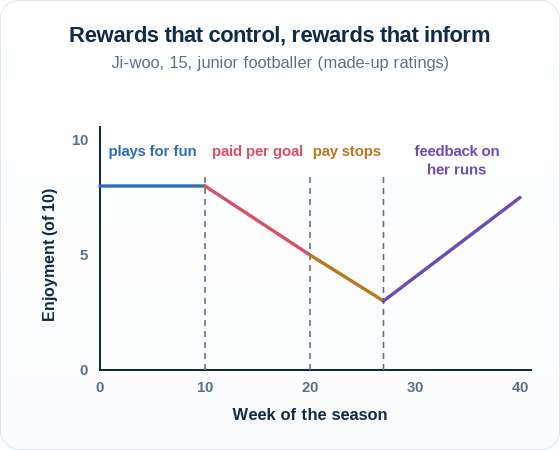
A footballer's enjoyment across a season of controlling and informational rewards
Recap: Ji-woo's season.

The four subtypes of extrinsic motivation, from least to most internalized.
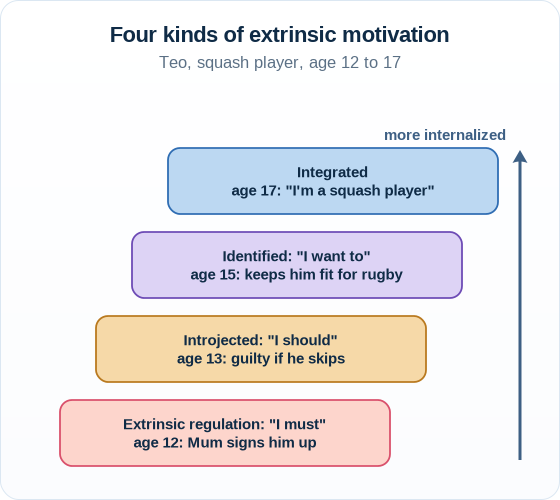
Four rungs of extrinsic motivation rising with internalization
Recap: four rungs of extrinsic motivation.

Inside My Learning

Turn these notes into practice

Try each question, reveal a clear model answer, and learn how to build your response.

  • 1.Explain how paying a child to train could reduce her intrinsic motivation. [2]
  • 2.Identify the OIT subtype: *I train because I would feel guilty if I didn't.* [1]
  • 3.Identify the causal orientation of a player focused on trophies and selectors' praise. [1]
Claim your free topic

Key terms, one line each:

TermIn one line
Cognitive evaluation theoryhow rewards affect intrinsic motivation
Overjustification effecta controlling reward undermines enjoyment
Introjected regulationacting to avoid guilt or shame
Integrated regulationextrinsic motivation aligned with personal values
Causal orientationa person's general source of motivation

Inside My Learning

Turn these notes into practice

Try each question, reveal a clear model answer, and learn how to build your response.

  • 1.Positive feedback on pacing: informational or controlling?
  • 2.Is introjected a causal orientation?
  • 3.Anxiety about competence: which orientation?
Claim your free topic
IB-style questionExplain[3 marks]

A runner's watch shows her pace improving each week. Explain how this affects her motivation, using cognitive evaluation theory.

Model answer plan

See the mark-by-mark plan — for / against / judgement, with marking guidance — in study mode.

Claim your free topic →

Exam tips

  • Name the overjustification effect when a controlling reward undermines enjoyment.
  • Each OIT subtype needs what regulates it and an example from the sport.
  • All four OIT subtypes are extrinsic; only integrated is largely internalized.
  • Introjected and identified are not causal orientations.
  • Basic needs theory predicts well-being and performance.

What you'll learn in Topic 9.2

  • 9.2.1 Self-determination theory
  • 9.2.2 The motivation continuum
  • 9.2.3 Cognitive evaluation theory
  • 9.2.4 Organismic integration
  • 9.2.5 Causal orientations
  • 9.2.6 Needs, goals and relatedness
Suggested study order: Read the notes for each sub-topic below → test yourself with flashcards → attempt practice questions → review exam technique.

Study resources — 9.2 Self-determination

9.2.1

Self-determination theory

Notes
9.2.2

The motivation continuum

Notes
9.2.3

Cognitive evaluation theory

Notes
9.2.4

Organismic integration

Notes
9.2.5

Causal orientations

Notes
9.2.6

Needs, goals and relatedness

Notes

Ready to study Self-determination?

Get expert practice questions with instant AI feedback, and a study planner tailored to your IB Sports, Exercise and Health Science HL exam date.

Start studying free

Topic 9.2 Self-determination forms a core part of Unit 9: Motivation in IB Sports, Exercise and Health Science HL. Mastering these concepts will strengthen your understanding of connected topics across the syllabus and prepare you for exam questions that require analysis, evaluation, and real-world application.

Previous topic
9.1 Achievement motivation
Next topic
9.3 Motivational climate
All Sports, Exercise and Health Science HL topics
Exam technique

Ready to practice?

Get AI-graded practice questions, mock exams, flashcards, and a personalised study plan — all aligned to your IB syllabus.

Start Studying Free

No credit card required · No time limit