aımnova
DashboardMy LearningCrash CoursesStudy Plan

Aimnova site navigation

Stay in the loop

Get the latest study resources and updates

New features, study tips and exam insights — straight to your inbox.

IB Diploma

  • IB Past Papers
  • IB Study Notes
  • IB Question Bank
  • IB Mock Exams
  • IB Revision

IB Subjects

  • IB Math AA
  • IB Math AI
  • IB Economics
  • IB Business Management
  • IB Physics
  • IB Biology
  • View all IB subjects→

IB Past Papers

  • IB Math AA HL Past Papers
  • IB Math AA SL Past Papers
  • IB Math AI HL Past Papers
  • IB Math AI SL Past Papers
  • IB Economics HL Past Papers
  • IB Economics SL Past Papers
  • IB ESS Past Papers
  • View all past papers→

Study Resources

  • Study Notes
  • Question Bank
  • Mock Exams
  • Crash Courses
  • Flashcards
  • Revision Guide
  • Exam Skills
  • Command Terms
  • Grade Calculator
  • Exam Timetable 2027

Aimnova

  • Features
  • Pricing
  • For Teachers
  • For Schools
  • For Parents
  • About Us
  • Blog
  • Contact
aımnova

IB study, practice and feedback built around the real exam.

TermsPrivacyCookies·© 2026 Aimnova. All rights reserved.d9e1c61

Aimnova is not affiliated with or endorsed by the International Baccalaureate Organization (IB).

NotesSports, Exercise and Health Science HLTopic 9.1
Unit 9 · Motivation · Topic 9.1

IB Sports, Exercise and Health Science HL — Achievement motivation

Achievement motivation

Higher Level students should use this topic hub as a map: start with the shared sub-topics, then follow the HL-only extensions and exam-skill links where this topic asks for deeper analysis.

Exam technique guidePractice questions

Key concepts in Achievement motivation

Start here: Questions on this topic ask you to classify aims and spot when high ego becomes a problem. Check perceived ability and task orientation before you judge an ego-oriented athlete.

1. Need achievement theory

  • A chain: personality and situational factors, then resultant, emotional, behavioural.
  • High achievers approach: effort, persistence, seek challenge and feedback.
  • Failure avoiders avoid: they fear failure and pick very easy or impossible tasks.
  • Coaches change the situation: challenging but achievable goals, feedback that rewards effort.

2. Goal orientation theory

  • Task orientation: success judged against yourself (self-referenced).
  • Ego orientation: success judged against others (norm-referenced).
  • Two separate scales: a player can be high on both.
  • High task orientation: more effort and perseverance.

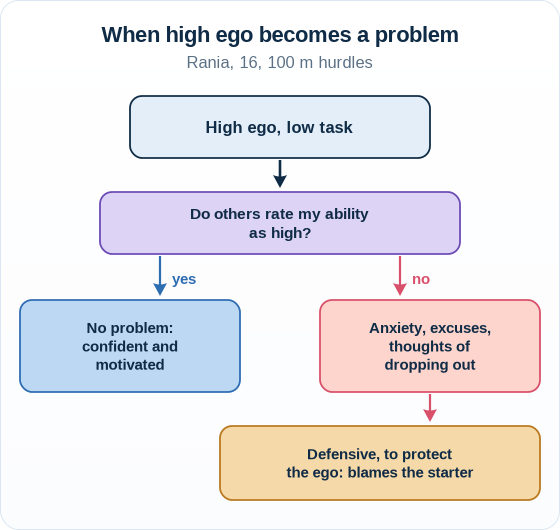
3. Problems with high ego (HL)

  • High ego is a problem when task orientation is low.
  • High perceived ability: confidence. Low perceived ability: anxiety, avoidance, dropout.
  • Challenged, the athlete turns defensive: excuses, even cheating.
  • High task orientation protects: perseverance after failure.

Need achievement theory as a chain of four steps.
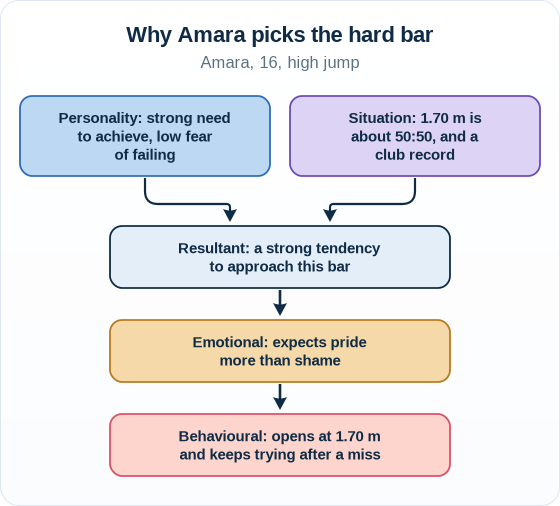
Need achievement theory as a chain of four steps for a high jumper
Recap: the four steps in order.

When high ego becomes a problem.

Decision tree from high ego and low task orientation to confidence or to anxiety, excuses and defensiveness
Recap: one question decides the outcome.

Inside My Learning

Turn these notes into practice

Try each question, reveal a clear model answer, and learn how to build your response.

  • 1.Outline two behaviours of an athlete with a high need to achieve. [2]
  • 2.Classify the aims *be top scorer* and *improve my first-touch*. [2]
  • 3.Outline two situational factors a coach could change to encourage approach behaviour. [2]
Claim your free topic

Key terms, one line each:

TermIn one line
Need to achievemotive to approach challenges
Need to avoid failuremotive to escape the shame of failing
Task orientationsuccess judged by self-improvement
Ego orientationsuccess judged by beating others
Perceived abilityhow able athletes believe they are

Inside My Learning

Turn these notes into practice

Try each question, reveal a clear model answer, and learn how to build your response.

  • 1.A personal best: task or ego?
  • 2.Can someone be high in both task and ego?
  • 3.Picking a very easy opponent: approach or avoid?
Claim your free topic
IB-style questionExplain[3 marks]

A young tennis player always picks weaker practice partners. Explain this using need achievement theory, and suggest one change for the coach.

Model answer plan

See the mark-by-mark plan — for / against / judgement, with marking guidance — in study mode.

Claim your free topic →

Exam tips

  • Task = self-referenced; ego = norm-referenced.
  • Task and ego are separate scales.
  • Avoiding challenges with ego goals points to low perceived ability.
  • Cheating when talent is doubted points to high ego orientation.

What you'll learn in Topic 9.1

  • 9.1.1 Need achievement theory
  • 9.1.2 Goal orientation theory
  • 9.1.3 Problems with high ego
Suggested study order: Read the notes for each sub-topic below → test yourself with flashcards → attempt practice questions → review exam technique.

Study resources — 9.1 Achievement motivation

9.1.1

Need achievement theory

Notes
9.1.2

Goal orientation theory

Notes
9.1.3

Problems with high ego

Notes

Ready to study Achievement motivation?

Get expert practice questions with instant AI feedback, and a study planner tailored to your IB Sports, Exercise and Health Science HL exam date.

Start studying free

Topic 9.1 Achievement motivation forms a core part of Unit 9: Motivation in IB Sports, Exercise and Health Science HL. Mastering these concepts will strengthen your understanding of connected topics across the syllabus and prepare you for exam questions that require analysis, evaluation, and real-world application.

Previous topic
8.2 Attentional control
Next topic
9.2 Self-determination
All Sports, Exercise and Health Science HL topics
Exam technique

Ready to practice?

Get AI-graded practice questions, mock exams, flashcards, and a personalised study plan — all aligned to your IB syllabus.

Start Studying Free

No credit card required · No time limit