Start here: Most questions on this topic are on projectile flight paths, then drag and the Magnus effect. Link every condition to fluid density or relative speed, then to the force, then to performance.
1. Projectiles
- Path set at release by speed, angle and height; then only gravity and drag act.
- Released above landing height: best angle below 45°; below it: above 45°.
- High drag for its weight: a lopsided path.
2. Environment and buoyancy
- Altitude, temperature and humidity change air density; wind changes relative speed.
- Buoyancy = weight of fluid displaced; salt water is denser, so more buoyancy, less drag.
- Denser fluid or faster flow: bigger fluid forces.
3. Lift, Magnus and drag
- Bernoulli: faster air, lower pressure; force acts from high to low pressure.
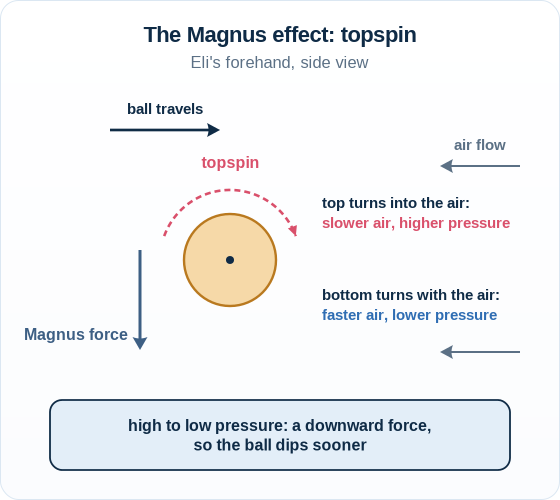
- Magnus: spin makes a pressure difference; topspin dips the ball.
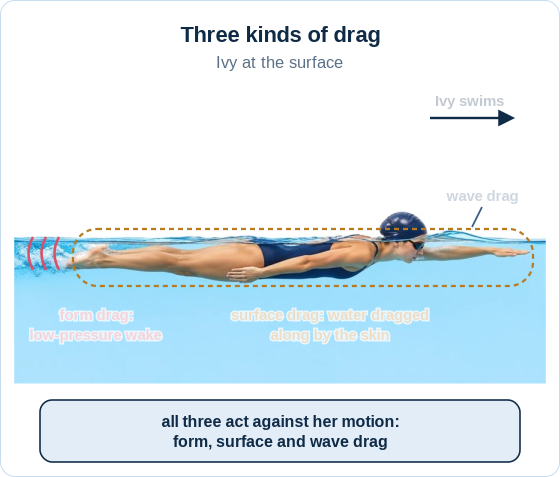
- Form (shape, frontal area), surface (friction) and wave drag.
4. Implications
- Changing buoyancy, lift or drag changes results.
- Weigh sporting, ethical (fair, safe, open to all) and regulatory points.
- Real cases: the 2010 swimsuit ban, the 1986 javelin redesign.
Topspin: higher pressure above, a downward Magnus force.
Three kinds of drag on a swimmer.
Key terms, one line each:
| Term | In one line |
|---|---|
| Buoyancy | upward force equal to the weight of fluid displaced |
| Bernoulli principle | faster flow, lower pressure |
| Magnus effect | a sideways force on a spinning ball |
| Form drag | from shape and frontal area |
| Angle of attack | angle between an object and the airflow |
IB-style questionDiscuss[4 marks]
Discuss the decision to ban full-body polyurethane swimsuits in 2010.
Model answer plan
See the mark-by-mark plan — for / against / judgement, with marking guidance — in study mode.
Exam tips
- Link each condition to density or relative speed before the force.
- A spinning ball curves because of a pressure difference, not uneven gravity.
- Draw drag from the body, opposite to its motion.
- Keep sporting, ethical and regulatory points apart.
- Discuss means both sides and a conclusion.