Start here: Questions on this topic are spread across all ten micros, led by Newton's laws, describing motion and friction. Write the equation, the numbers and the unit, and give a direction with every momentum change.
1. Motion and Newton's laws
- Acceleration = (v − u) ÷ t; the gradient of a velocity-time graph.
- F = m × a; third-law pairs act on two different bodies.
- Stable: low centre of mass, wide base, line of gravity inside the base.
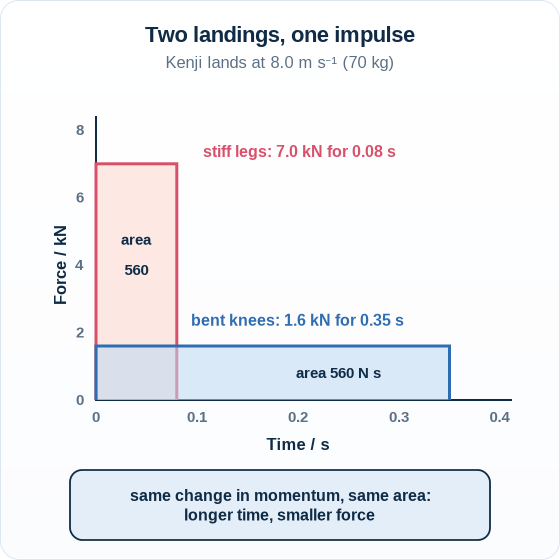
- Impulse = resultant F × t = change in momentum; angular momentum constant in the air.
2. Collisions and restitution
- In a collision the two impulses are equal and opposite: total momentum is conserved.
- CR = (vb − vₐ) ÷ (uₐ − ub), speed of separation ÷ speed of approach, 0 to 1, no unit.
- CR depends on the materials, temperature and pressure, not on hitting speed.
3. Friction
- Friction = coefficient × normal reaction force: Ff ≤ μₛ FN before sliding, Ff = μd FN once sliding.
- Static friction grows to a maximum; once sliding, the lower dynamic coefficient applies.
- Raise it to push or grip (spikes, wax, chalk); lower it to glide (waxed skis, swept ice).
4. Work and power
- Work = force × distance in the force's direction, in joules; no movement, no work.
- Energy changes form: kinetic, elastic, gravitational potential, heat.
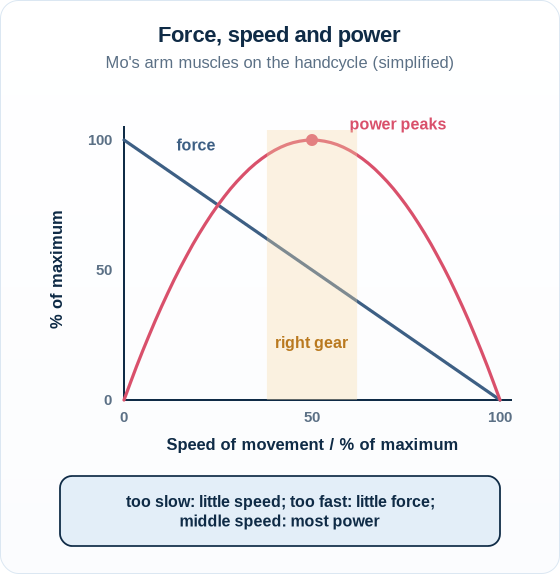
- Power = work ÷ time = force × velocity, in watts; greatest at a middle speed.
Two landings: the same impulse, spread over different times.
Force, velocity and power: the peak sits at a middle speed.
Key terms, one line each:
| Term | In one line |
|---|---|
| Impulse | resultant force × time; equals the change in momentum |
| Conservation of momentum | total momentum unchanged with no outside force |
| Coefficient of restitution | separation speed ÷ approach speed |
| Normal reaction force | the surface's push at right angles to it |
| Work | force × distance moved in its direction |
| Power | rate of doing work, in watts |
IB-style questionExplain[4 marks]
Two ice hockey players collide and move off together. Explain the collision using momentum.
Model answer plan
See the mark-by-mark plan — for / against / judgement, with marking guidance — in study mode.
Exam tips
- Show the equation, the numbers and the unit: a lone answer is risky.
- Give a direction with every momentum change or force.
- CR has no unit and lies between 0 and 1.
- In the friction equation the force is the normal reaction, often equal to the weight.
- Power = work ÷ time: calculate it for every trial before choosing.