Studying this at HL: HL papers ask you to pick out a discrete skill, name the phase a coach's feedback is about, and outline the force production, critical instant and follow through of a stroke. The phase names must be exact.
The big idea: A fast movement is easier to analyse in pieces. Every movement is cut into preparatory, force production and the critical instant, then follow through for a discrete skill or recovery for a continuous one.
Our example: Wen plays outside hitter in volleyball. Her spike is our discrete skill; the front crawl she swims for fitness is our continuous one.
See it drawn, step by step
In My Learning, handwritten diagrams build one step at a time. Play, pause and replay each explanation until it clicks. Create your free account to try it.
A kinogram: A row of frames like this, taken from slow-motion video or motion capture, is a kinogram. It makes each phase easy to see and compare.
Free preview
This is the free notes preview
You're reading the free notes. Aimnova Pro unlocks the full study experience — and you can try it with your first topic free to keep:
- FlashcardsLock in vocabulary and key terms with spaced repetition.
- Practice questionsAnswer exam-style questions and get instant AI marking.
- Mock exams & past-paper vaultSit full mocks and see exactly how examiners award marks.
- Personalised study planA daily plan built around your exam date and weak areas.
Front crawl has no clear end: one arm cycle runs straight into the next. That makes it a continuous skill, so the fourth phase is recovery.
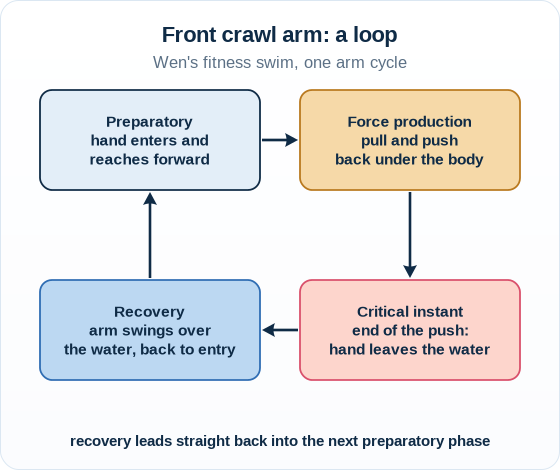
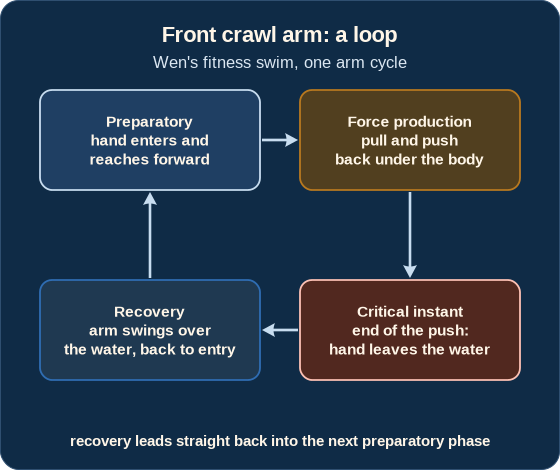
Same first three names: Preparatory, force production and critical instant keep their names in every skill. Only the fourth changes: follow through if the skill is over, recovery if it starts again.
Get feedback like a real examiner
Submit your answers and get instant feedback — what you did well, what's missing, and exactly what to write to score full marks.
Before naming the fourth phase, decide what kind of skill it is.
Discrete: clear start and end
- Springboard dive, spike, serve, golf swing, penalty kick
- Done once, then over
- Fourth phase: follow through
Continuous: cycles repeat
- Swimming, running, cycling, rowing, race walking, cross-country skiing
- No obvious start or end
- Fourth phase: recovery
What each phase is for
| Phase | What happens | Watch for |
|---|---|---|
| Preparatory | Body positioned; muscles stretched and loaded | Balance, range of the backswing |
| Force production | Body parts move towards the ball or target in sequence | Timing of the chain |
| Critical instant | One moment: contact or release | Where and how contact happens |
| Follow through | Movement continues after contact | Accuracy, control, slowing safely |
A moment, not a stretch: The critical instant is a single moment. If what you describe takes time, such as swinging the arm, it is still force production.
How this is tested — you name a phase, recognise a discrete skill, or outline the phases of a stroke. It comes up two ways:
Paper 1 — recall and data
- Paper 1A: which skill is discrete
- Which phase a coach's feedback is about
Paper 2 — explain and evaluate
- Paper 2 asks you to outline named phases of a stroke
- One mark per phase, each tied to the skill
Point force production at the ball: Force production must say the body moves towards the ball or target. Muscles produce force alone is too vague.
For a volleyball float serve, outline what happens in the force production phase, at the critical instant and in the follow-through.
Model answer plan
See the answer broken into clear points, with guidance on how each point earns marks.
Exam tips
- Force production must mention movement towards the ball or target.
- The critical instant is the moment of contact or release: racket meets ball, club meets ball, hand lets go.
- Follow through: the movement carries on after contact; add what it does, such as accuracy, control or lower injury risk.
- Feedback about the impact point between club and ball is about the critical instant.
- A springboard dive is discrete; swimming, race walking and cross-country skiing are continuous.