The big idea: A star radiates like a black body. Two laws read its light: one gives its temperature, the other its total power.
Metal in a furnace: Watch metal in a furnace: as it heats it glows from dull red to orange to brilliant white. Its colour betrays its temperature. A star does the same.
The two laws
- The colour of the peak tells you how hot the surface is — that is Wien's law
- The total power it pours out depends on its size and temperature — that is the Stefan-Boltzmann law
Animated graph
Watch the graph build step by step in study mode.
New words, plainly
- Black body = an ideal object that absorbs all radiation falling on it and glows with a characteristic spectrum set only by its temperature. A star is a good approximation.
- Peak wavelength λmax = the wavelength at which the star radiates most intensely — the top of its curve.
- Luminosity L = the total power the star radiates, in watts (W). (Brightness as seen from Earth is something else — that fades with distance.)
Wien's law — the COLOUR
- Looks at where the peak is (the colour)
- Hotter star → peak at a shorter wavelength (bluer)
- Gives you the surface temperature T
Stefan-Boltzmann — the POWER
- Looks at the total power radiated (luminosity L)
- Depends on the area and on T⁴ — a tiny T rise is huge
- Links luminosity, radius and temperature together
Hotter = bluer AND brighter: As a star gets hotter two things happen at once on its curve:
- the peak slides to a shorter wavelength (it looks bluer) — Wien, - the whole curve rises (it radiates far more power) — Stefan-Boltzmann.
So a blue star is both hotter and, size for size, much more luminous than a red one.
Free preview
This is the free notes preview
You're reading the free notes. Aimnova Pro unlocks the full study experience — and you can try it with your first topic free to keep:
- FlashcardsLock in vocabulary and key terms with spaced repetition.
- Practice questionsAnswer exam-style questions and get instant AI marking.
- Mock exams & past-paper vaultSit full mocks and see exactly how examiners award marks.
- Personalised study planA daily plan built around your exam date and weak areas.
Measure where the spectrum peaks, λmax, and Wien's law gives you the star's surface temperature straight away. Shorter peak ⇒ hotter star.
- peak wavelength — where the star's radiation is most intense (m)
- surface (absolute) temperature of the star (K)
- Wien's constant, 2.9 × 10⁻³ m K (given)
Watch the units: Put λmax in metres (a wavelength of 480 nm is 480 × 10⁻⁹ m) and T comes out in kelvin (K).
Rearrange the given law for whichever you need:
- temperature from the peak: T = 2.9 × 10⁻³ ÷ λmax - peak from the temperature: λmax = 2.9 × 10⁻³ ÷ T
A star's black-body spectrum peaks at a wavelength of λmax = 480 nm. Determine the surface temperature of the star. (Wien's constant = 2.9 × 10⁻³ m K.)
Model answer plan
See the answer broken into clear points, with guidance on how each point earns marks.
Get feedback like a real examiner
Submit your answers and get instant feedback — what you did well, what's missing, and exactly what to write to score full marks.
The Stefan-Boltzmann law gives the total power a star radiates. For a star the radiating area is the surface of a sphere, A = 4πR², so the law connects luminosity, radius and temperature in one equation.
- luminosity — the total power the star radiates (W)
- Stefan-Boltzmann constant, 5.67 × 10⁻⁸ W m⁻² K⁻⁴ (given)
- surface area of the star; for a sphere A = 4πR² (m²)
- surface (absolute) temperature of the star (K)
The T⁴ is the key: Because the temperature is raised to the fourth power, it dominates. Double the temperature and the luminosity jumps by 2⁴ = 16 times (radius unchanged).
The radius only enters as R² (double R → 4× the luminosity).
For comparing two stars, use the proportional form L ∝ R² T⁴ — the constants cancel.
| If you change… | What happens to luminosity L |
|---|---|
| Double the radius R (T fixed) | Area is 4πR², so L goes up 4× (L ∝ R²) |
| Double the temperature T (R fixed) | L goes up 16× — because of the T⁴ |
| Double both R and T | L goes up 4 × 16 = 64× |
Comparing two stars — the ratio trick: When a question gives one star's values and asks about a second, divide the two Stefan-Boltzmann equations so σ and 4π cancel:
LB ÷ LA = (RB ÷ RA)² × (TB ÷ TA)⁴
Then rearrange for the radius ratio: RB ÷ RA = √(LB ÷ LA) ÷ (TB ÷ TA)².
From telescope data to a star's radius
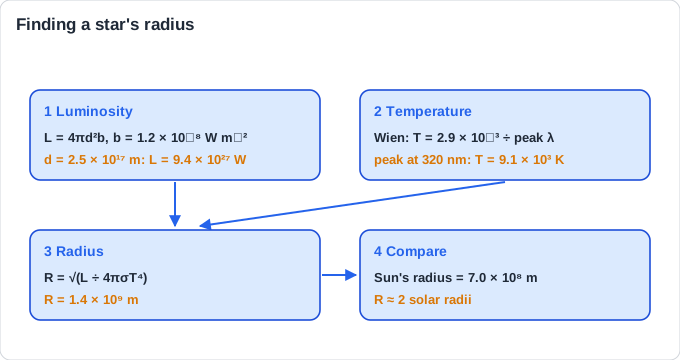
Work in solar units: Divide by the Sun's values and σ and 4π cancel: L/L☉ = (R/R☉)² × (T/T☉)⁴. A star of 0.9 R☉ at 5200 K: L/L☉ = 0.9² × (5200/5800)⁴ = 0.81 × 0.65 = 0.52, about half the Sun's.
Star Y has 4 times the luminosity and 2 times the surface temperature of Star X. Determine the ratio of Star Y's radius to Star X's radius.
Model answer plan
See the answer broken into clear points, with guidance on how each point earns marks.
How this is tested — the two laws appear on both papers, almost always together:
Paper 1A
- A one-step MCQ — read off which star is hotter from its peak.
- Or find a radius ratio of two stars from their luminosities and temperatures (L ∝ R²T⁴).
Paper 2
- Show that the surface temperature is about a stated value from the spectrum peak (Wien).
- Then estimate the radius by combining the laws (often via b = L/4πd² to get L first).
The classic trap: Forgetting the T⁴. When you take the ratio, the temperature ratio is raised to the fourth power and the radius ratio to the second — and λmax must be in metres for Wien.
Star X has a black-body peak at λmax = 580 nm and Star Y has a peak at λmax = 290 nm; Star Y is also 4 times as luminous as Star X. (a) Determine the surface temperature of each star. (b) Determine the ratio of Star Y's radius to Star X's radius. (Wien's constant = 2.9 × 10⁻³ m K.)
Model answer plan
See the answer broken into clear points, with guidance on how each point earns marks.