Where it lives, and how it lives: A niche is the whole way a species lives. Its habitat is only the place.
The points to remember
- A niche is the set of abiotic and biotic conditions and resources a species depends on.
- It is the species' role in the ecosystem: all its interactions with living and non-living things.
- It covers everything that affects its growth, survival and reproduction, including how it gets food.
- A habitat is only where it lives.
- Many species share a habitat, but each species has its own niche.
Remember it as: Habitat: where it lives. Niche: how it lives there.
Habitat
- The place, or kind of environment.
- Shared by many species.
Niche
- All its conditions, resources and interactions.
- Particular to one species.
Real example: robins and blue tits share the same habitat, a UK garden. But robins feed on worms and insects on the ground, while blue tits pick tiny insects off twigs: different niches.
Write 'role', not 'job': Describe a niche as the species' role or all its interactions. 'Its job' is not accepted.
Free preview
This is the free notes preview
You're reading the free notes. Aimnova Pro unlocks the full study experience — and you can try it with your first topic free to keep:
- FlashcardsLock in vocabulary and key terms with spaced repetition.
- Practice questionsAnswer exam-style questions and get instant AI marking.
- Mock exams & past-paper vaultSit full mocks and see exactly how examiners award marks.
- Personalised study planA daily plan built around your exam date and weak areas.
To describe a niche, list its parameters for one named species.
The parameters of a niche
- Conditions: the range of temperature, pH, salinity, dissolved oxygen or sunlight it can live in.
- Food: what it eats and how it gets it (hunting, grazing, filtering, diving).
- Resources: water, nest sites, shelter, space.
- Interactions: its predators, prey, competitors, parasites and partners.
- Timing: when it is active (day or night) and when it breeds.
- Disturbance: how much disturbance it can stand.
Remember it as: Conditions, food, resources, other species, timing.
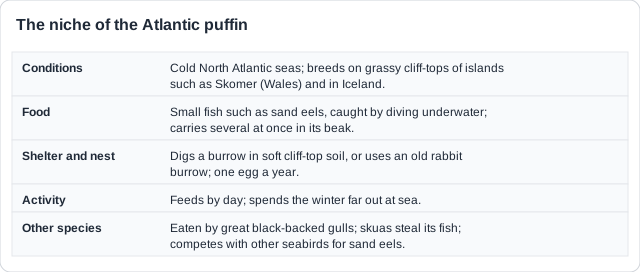
Reading it: the puffin depends on cold seas with plenty of sand eels, and on soft soil for its burrows. Take away either, and it cannot breed there.
Name the species: A niche answer with no named species cannot get full marks. Each condition must fit that species.
See how examiners mark answers
Access past paper questions with model answers. Learn exactly what earns marks and what doesn't.
Papers give fact files of two species and ask you to compare their niches, or to explain a change.
Comparing niches, and niches that change
- To compare niches, give a similarity ('both ...') and a difference ('..., whereas ...').
- Different niches let species share a habitat, so more niches means more species can live there.
- A niche shrinks when a competitor, predator or disease arrives, or when food or nest sites are lost.
- A niche can also change when conditions change, e.g. warmer water.
- Species with a broad niche (varied food, many places to live) recover faster after a disaster.
Remember it as: Both ... whereas ... : one of each.
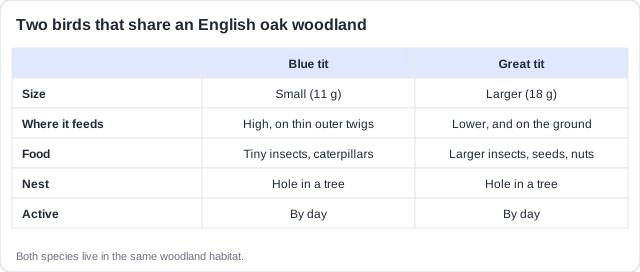
Comparing: both nest in tree holes and feed by day, whereas blue tits feed high on tiny insects and great tits feed lower, on larger food.
Real example: a niche that shrank: In many English rivers, invasive American signal crayfish take the best hiding places under stones and carry a disease, crayfish plague. The native white-clawed crayfish now survives mainly in streams the invaders have not reached.
How this comes up: Paper 2, Section B (a): distinguish niche and habitat, or outline four conditions of a named species' niche [4]. Paper 1: compare two species' niches from a fact file [3].
A nature guide says that red foxes 'live everywhere' in British towns.
Distinguish between the terms niche and habitat with reference to a named species.
Model answer plan
See the mark-by-mark plan — for / against / judgement, with marking guidance — in study mode.