A community and its surroundings: An ecosystem is a community and the physical environment with which it interacts.
The points to remember
- An ecosystem is a community plus the physical environment it interacts with.
- Living parts are biotic; non-living parts (soil, water, air, light, temperature) are abiotic.
- Name a local ecosystem precisely: 'deciduous woodland', 'freshwater pond', 'salt marsh'.
- Not enough: a broad group ('terrestrial', 'freshwater ecosystem') or just 'forest'.
- Not an ecosystem: a biome ('taiga biome') is a much larger, worldwide group.
- Ecosystems come in any size: a pond, a wood, a whole reef.
Remember it as: Community + surroundings = ecosystem. Name it exactly, never just 'forest'.
Precise enough
- Temperate deciduous woodland
- Freshwater pond
- Salt marsh
Too broad
- Forest
- Terrestrial ecosystem
- Taiga biome
Real example: Richmond Park, London, holds several ecosystems side by side: acid grassland, ancient oak woodland and freshwater ponds.
Free preview
This is the free notes preview
You're reading the free notes. Aimnova Pro unlocks the full study experience — and you can try it with your first topic free to keep:
- FlashcardsLock in vocabulary and key terms with spaced repetition.
- Practice questionsAnswer exam-style questions and get instant AI marking.
- Mock exams & past-paper vaultSit full mocks and see exactly how examiners award marks.
- Personalised study planA daily plan built around your exam date and weak areas.
Open and closed systems were met in 1.2.5. Every real ecosystem is open.
The points to remember: open systems
- Ecosystems are open systems: both energy and matter cross their boundary.
- Energy enters as sunlight and leaves as heat.
- Matter enters and leaves: water, nutrients and soil, gases, and living things.
- Living things cross too: seeds blown in, animals migrating or wandering out.
- We draw the boundary, so what counts as an input depends on where we draw it.
Remember it as: Sunlight in, heat out. Water, nutrients, gases and living things in and out.
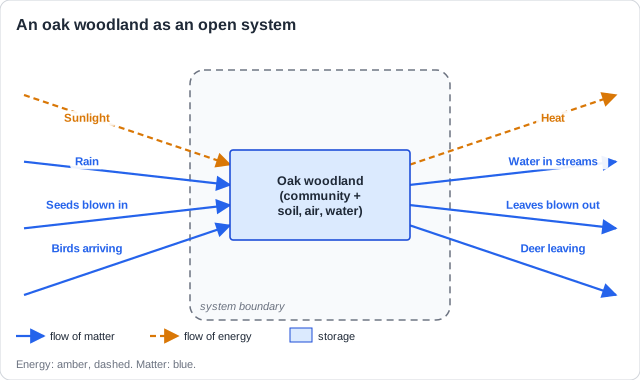
Real example: in a wood, rain falls in and leaves by streams; jays carry acorns in, and deer wander out to feed in fields.
Memorize terms 3x faster
Smart flashcards show you cards right before you forget them. Perfect for definitions and key concepts.
Neighbours share their flows: Along warm coasts, mangroves, seagrass and coral reefs sit side by side and pass matter and energy between them.
The points to remember: when one ecosystem is lost
- Open ecosystems are linked, so losing one affects its neighbours.
- Less protection from storm waves and currents for the ecosystem behind it.
- Fewer nursery and breeding grounds for species that move between them.
- Less organic matter and nutrients passed on to the neighbour.
- Cloudier water without filtering or trapping, so less light for photosynthesis.
- Species move in, raising competition; fewer grazing fish can even mean more seagrass.
- Fewer tourists, so less money to protect the neighbouring ecosystem.
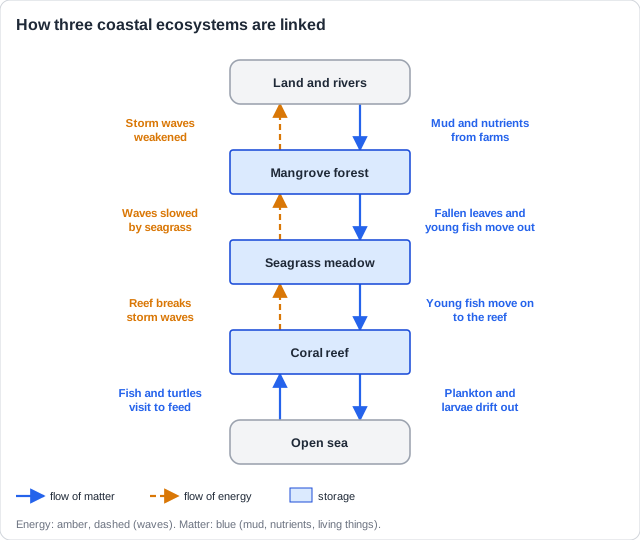
Say what happens to the neighbour: 'Biodiversity is lost' or 'the water is cloudier' alone is not enough: say how it harms the neighbouring ecosystem.
Real example: in the Florida Keys, USA, mangroves, seagrass meadows and coral reefs lie side by side, and many reef fish, such as grey snapper, grow up in the mangroves and seagrass first.
How this comes up: Paper 1 [1]: identify an ecosystem from a map. Paper 1 [2]: outline how losing one ecosystem affects its neighbour.
Figure 1 shows how mangroves, seagrass and a coral reef are linked along a tropical coast. Mangroves are being cleared to build shrimp farms.
With reference to Figure 1, outline how loss of the mangrove forest could impact the seagrass meadow.
Model answer plan
See the mark-by-mark plan — for / against / judgement, with marking guidance — in study mode.