Many populations, living together: A community is a collection of interacting populations within an ecosystem. Each population is one species.
The points to remember
- A community is all the populations of different species living in the same area at the same time.
- The populations interact: they eat, compete with, help or infect each other.
- It is only the living part: plants, animals, fungi and microorganisms.
- It includes producers, consumers and decomposers.
- Add the physical environment (soil, water, air, light) and you have an ecosystem.
Remember it as: One species = population. Many species, interacting = community.
Community
- Living things only
- Many species, interacting
Ecosystem
- Community plus soil, water, air and light
- Living and non-living parts
Say 'interacting': A community is not just a list of species in a place: the populations must interact.
Real example: a single old oak tree in England supports a community of about 2,300 species, from caterpillars and beetles to birds, bats, mosses and fungi.
Free preview
This is the free notes preview
You're reading the free notes. Aimnova Pro unlocks the full study experience — and you can try it with your first topic free to keep:
- FlashcardsLock in vocabulary and key terms with spaced repetition.
- Practice questionsAnswer exam-style questions and get instant AI marking.
- Mock exams & past-paper vaultSit full mocks and see exactly how examiners award marks.
- Personalised study planA daily plan built around your exam date and weak areas.
The populations in a community depend on each other. Population interactions are studied in detail in 2.1.9.
How populations in a community interact
- Feeding: herbivores eat plants; predators eat other animals.
- Competition: populations need the same food, light or space.
- Mutualism: both gain, such as bees pollinating flowers.
- Parasitism and disease: one population lives on or harms another.
- A change in one population ripples through the rest of the community.
Remember it as: Eat, compete, help, infect: and every change ripples.
A local community: on an oak, caterpillars eat the leaves, blue tits eat the caterpillars, and fungi on the roots swap nutrients with the tree (mutualism).
Studying a community near you: List the species in one place, such as a hedge or a pond, then draw arrows for who eats, helps or competes with whom.
Practice with real exam questions
Answer exam-style questions and get AI feedback that shows you exactly what examiners want to see in a full-marks response.
Why carnivores keep a community stable: Carnivores hold the other populations in check, so the whole community stays in balance.
The points to remember: carnivores and stability
- Negative feedback: more herbivores, more carnivores; then fewer herbivores, so fewer carnivores.
- So carnivores regulate population sizes, and herbivores do not strip the plants bare.
- Their faeces and dead bodies feed the decomposers, which recycle nutrients.
- Carnivores compete with each other for prey and space, which limits their own numbers.
- They leave uneaten prey for scavengers, such as vultures and crows.
- A top carnivore can be a keystone species, holding many food chains together.
- They eat the most common herbivore, so rarer herbivore species can survive.
Remember it as: Feedback, regulate, feed decomposers, compete, scraps, keystone, eat the common one.
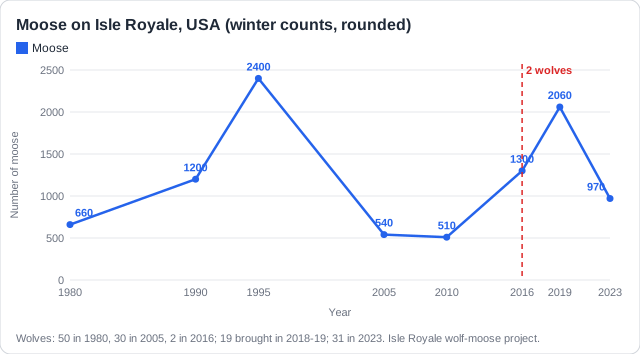
Real example: on Isle Royale, USA, only two wolves were left by 2016 and the moose rose to over 2,000, eating young trees. Wolves were brought back in 2018-19, and by 2023 the moose had fallen to about 970.
Link every point to stability: 'Carnivores eat herbivores' is not enough: say how it keeps the numbers in balance.
How this comes up: Paper 2, Section B (b): explain how a community of carnivores contributes to stability [7].
Wolves were brought back to Isle Royale, USA, in 2018 after they had almost died out.
Explain how a community of carnivores contributes to the overall stability of an ecosystem.
Model answer plan
See the mark-by-mark plan — for / against / judgement, with marking guidance — in study mode.