Negative feedback at Higher Level: The same idea as SL. At HL, test the limits: every negative loop works only within a range, and a big enough push breaks it.
Practise this as you read
- Draw a closed loop with a + or − on every arrow.
- Explain where a loop stops working.
Free preview
This is the free notes preview
You're reading the free notes. Aimnova Pro unlocks the full study experience — and you can try it with your first topic free to keep:
- FlashcardsLock in vocabulary and key terms with spaced repetition.
- Practice questionsAnswer exam-style questions and get instant AI marking.
- Mock exams & past-paper vaultSit full mocks and see exactly how examiners award marks.
- Personalised study planA daily plan built around your exam date and weak areas.
Write this for the definition mark: Negative feedback brings a system back towards normal after a change.
An everyday example: your body
- You get too hot.
- You sweat.
- The sweat evaporates and cools you.
- You are back to normal.
Negative does not mean bad: Negative does not mean bad. It means the response helps bring things back towards normal.
For example: you get too hot → you sweat → you cool down.
The exam example: clouds and global temperature.
See it drawn, step by step
In My Learning, handwritten diagrams build one step at a time. Play, pause and replay each explanation until it clicks. Create your free account to try it.
In the exam, write
- Definition: negative feedback brings a system back towards normal after a change.
- Stable means staying near the usual level (equilibrium), rather than changing further and further.
- Example: more hares provide food for more lynx. The lynx eat more hares, so hare numbers fall again.
- Close the loop: start with hare numbers rising and finish with hare numbers falling.
Remember it as: More hares → more lynx → more hares eaten → fewer hares. The loop reduces the original rise.
Lynx hunt snowshoe hares in Canada. When hare numbers rise, lynx have more food. More lynx survive and raise young. They then eat more hares, so hare numbers fall again. This reduces the original rise in hare numbers: negative feedback. Follow the arrows in the diagram below.
Negative feedback counteracts a change, so the numbers stay near a stable level.
Interactive diagram
Explore the labelled diagram, charts and maps for this topic in full study mode.
Learn what examiners really want
See exactly what to write to score full marks. Our AI shows you model answers and the key phrases examiners look for.
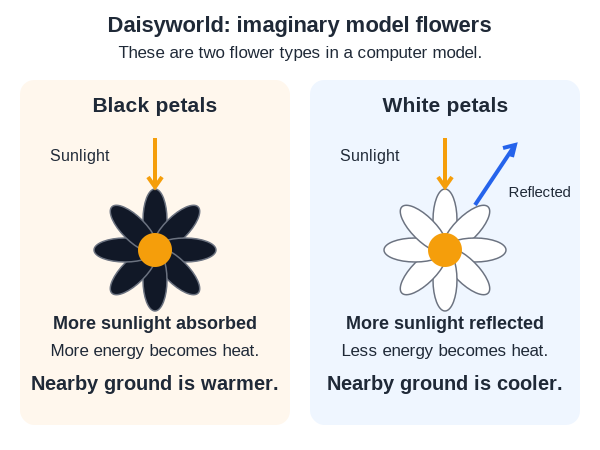
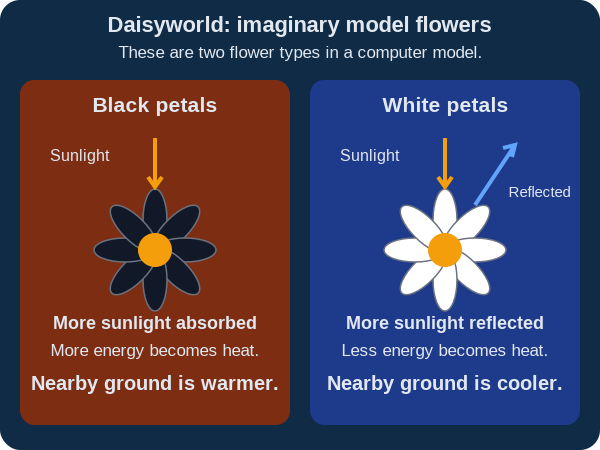
Daisyworld is a computer model by James Lovelock and Andrew Watson (1983). Its black and white daisies are imaginary.
How it works
- When it is cold, black daisies grow better: their petals absorb sunlight and warm the ground around them.
- When it is warm, white daisies grow better: their petals reflect sunlight and keep the ground around them cooler.
- More white daisies reflect more sunlight, so the planet warms less. This is negative feedback.
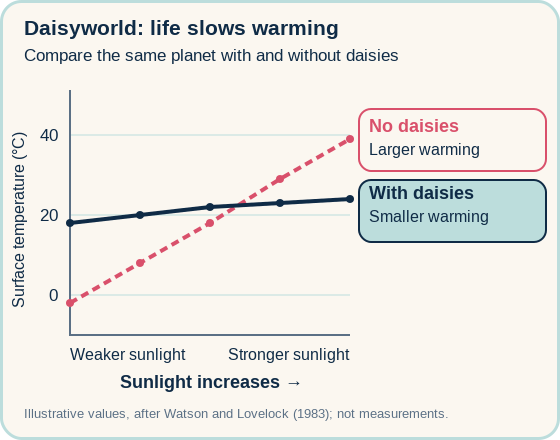
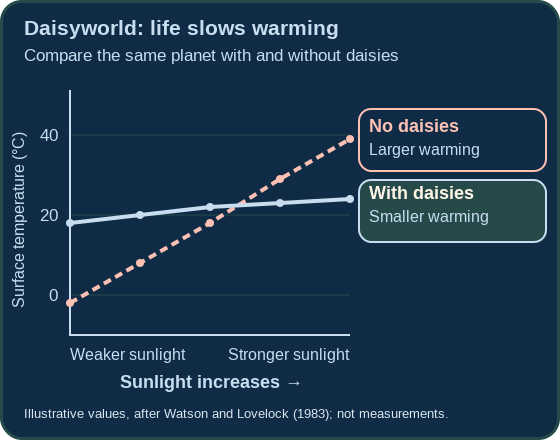
The limit: if it becomes too hot or too cold for the daisies to survive, this feedback stops.
In each example, follow the starting change and the response that reduces it.
The loops to know
- Clouds: warmer oceans evaporate more water. More cloud can form and reflect more sunlight back to space, reducing the warming.
- Plants: extra CO₂ can increase photosynthesis if other resources are available. Plants take up more CO₂, reducing the original rise.
- Predator and prey: more prey provide more food for predators. More predators survive and eat more prey, reducing prey numbers.
- Carrying capacity: a growing population uses more food. When food becomes scarce, fewer young survive and population growth slows.
- Deaths: a larger population can experience more disease and competition for food. More deaths then reduce population growth.
- Body temperature: when hot, sweating cools you; when cold, shivering warms you. Both responses move temperature towards normal.
Clouds can have two different effects. They reflect sunlight arriving from the Sun, but they can also trap heat leaving Earth. Which effect is stronger depends on the cloud type.
| Cloud type | What it does | Overall effect |
|---|---|---|
| Low, thick clouds | Reflect a lot of incoming sunlight back to space. Less energy reaches the ground. | Usually cool the surface. |
| High, thin clouds | Let much sunlight through, but absorb some infrared radiation (heat) leaving Earth and send some back down. | Usually warm the surface. |
Never wonder what to study next
Get a personalized daily plan based on your exam date, progress, and weak areas. We'll tell you exactly what to review each day.
Drawing a feedback loop
- Start with the variable that changes, in a box.
- Add a box for each step, joined by arrows.
- Put a sign on each arrow: + when the two quantities change in the same direction; − when they change in opposite directions.
- Close the loop: the last arrow returns to the first box.
- Follow the arrows back to the first box. If the response reduces the starting change, it is negative feedback. If it makes the change bigger, it is positive feedback.
See it drawn, step by step
In My Learning, handwritten diagrams build one step at a time. Play, pause and replay each explanation until it clicks. Create your free account to try it.
A chain is not a loop: Draw a loop that returns to the starting variable.
How this comes up: Use a model such as Daisyworld to show regulation, or describe a negative loop step by step.
Outline how the Daisyworld model shows that life can regulate the temperature of a planet.
Model answer plan
See the answer broken into clear points, with guidance on how each point earns marks.
Name the feedback: Say 'negative feedback' and show the loop closing: warming leads to more reflection, which reduces warming.