Emergent properties at Higher Level: The same idea as SL. At HL, trace HOW the interactions create the property, step by step.
Practise this as you read
- Explain each step of a cascade.
- Find emergent properties in other topics.
Free preview
This is the free notes preview
You're reading the free notes. Aimnova Pro unlocks the full study experience — and you can try it with your first topic free to keep:
- FlashcardsLock in vocabulary and key terms with spaced repetition.
- Practice questionsAnswer exam-style questions and get instant AI marking.
- Mock exams & past-paper vaultSit full mocks and see exactly how examiners award marks.
- Personalised study planA daily plan built around your exam date and weak areas.
More than the sum of the parts: An emergent property appears only when the parts of a system interact. No single part has it.
The points to remember
- An emergent property appears only when the parts of a system interact.
- No single part has the property on its own.
- It is a pattern of change you would never see in the parts kept apart.
- Two examples to name: predator-prey cycles and trophic cascades.
- Because they come from interactions, emergent properties make systems hard to predict.
One part alone
- One tree does not make a forest's cool, damp climate.
- One grain of soil is not fertile.
Parts interacting
- Many trees together create shade and humidity.
- Minerals, water, organisms and air make fertile soil.
Remember it as: The whole does what no part can.
Feeling unprepared for exams?
Get a clear study plan, practice with real questions, and know exactly where you stand before exam day. No more guessing.
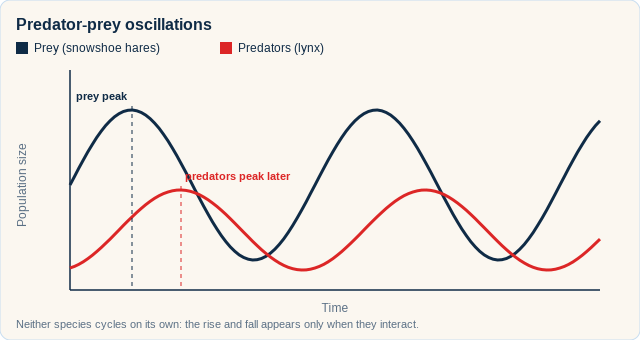
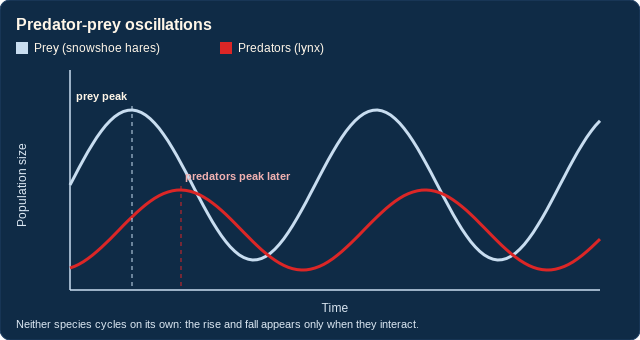
Put a predator and its prey together and a new pattern appears.
How the cycle arises
- More prey: predators have food and increase.
- More predators: prey are eaten and fall.
- Fewer prey: predators starve and fall, so prey recover.
- The predator peak comes after the prey peak, because predators take time to breed.
A trophic cascade is a change that passes down a food chain, level by level.
The points to remember
- A change at one level, often the top predator, passes down the food chain.
- Each level changes the one below it.
- Predator removed: grazers boom, plants lose. Predator back: grazers fall, plants recover.
See it drawn, step by step
In My Learning, handwritten diagrams build one step at a time. Play, pause and replay each explanation until it clicks. Create your free account to try it.
Why it is emergent: Otters do not grow kelp. The kelp forest exists only because otters, urchins and kelp interact.
A cascade also runs the other way, when a predator comes back. Wolves returned to Yellowstone National Park, USA, in 1995:
See it drawn, step by step
In My Learning, handwritten diagrams build one step at a time. Play, pause and replay each explanation until it clicks. Create your free account to try it.
Memorize terms 3x faster
Smart flashcards show you cards right before you forget them. Perfect for definitions and key concepts.
Emergent properties turn up throughout the course. Because they come from interactions, changing one part can have effects nobody predicted.
| Emergent property | Where | What interacts |
|---|---|---|
| Trophic cascades | 3.3 | Rewilding with top predators |
| Soil fertility | 5.2 | Soil organisms, minerals and water |
| Climate feedbacks | 6.3 | Ice, oceans and air amplify warming |
| Urban heat island | 8.3 | Buildings, roads and traffic warm a city |
| Resilience | 1.2.17 | Diversity lets a system absorb a shock |
How this could come up: Read a predator-prey graph, draw a trophic cascade, or explain emergent properties with examples [7].
Using examples, explain how interactions between components of a system can generate emergent properties.
Model answer plan
See the answer broken into clear points, with guidance on how each point earns marks.