A set of instructions: A set of instructions tells the reader how to do something, step by step — a recipe, a how-to guide, a set of rules.
Tasks where it fits
- How to stay safe online or protect your digital footprint
- How to get ready for a new rule or ban
- How to take part in an event or a project
Conventions the examiner checks
- A title that says what the reader will be able to do
- Numbered steps with imperatives ("Check…", "Turn off…")
- A short reason for each step and a closing warning or contact
Traps that cost Criterion C
- Steps out of order
- Polite requests instead of imperatives ("Could you maybe…")
- One paragraph with no numbering
Instructions in the exam
- Paper 1: choose it when the task asks you to explain how to make or do something.
- It is part of Unit 2: Text Types.
- Most of the marks come from getting its conventions and register right (Criterion C), not just the message.
- a set of instructions
- a text that tells the reader how to do something, step by step
- the title
- a heading that says what the reader will make or do
- a step
- one action the reader has to carry out, in order
- the imperative
- the command form of a verb: "peel", "add", "stir"
- sequence (order)
- the order the steps come in; first, next, then, finally
- a warning / a tip
- advice to be careful or to get a better result
- what you need
- the list of things or ingredients required before you start
Spot it in the task: The task asks you to explain a process. "Explain how to prepare…", "Write instructions for…" → a set of instructions.
If instead it said "Write to a friend to tell them about…" you would switch to an informal email (a different text type). Always read the command term first.
Free preview
Reading it is one thing — hearing it is another
You're reading the free notes. Aimnova Pro unlocks the full study experience — and you can try it with your first topic free to keep:
- Audio on every wordTap any vocabulary word or example to hear it read aloud in natural English.
- FlashcardsLock in vocabulary and key terms with spaced repetition.
- Practice questionsAnswer exam-style questions and get instant AI marking.
- Mock exams & past-paper vaultSit full mocks and see exactly how examiners award marks.
- Personalised study planA daily plan built around your exam date and weak areas.
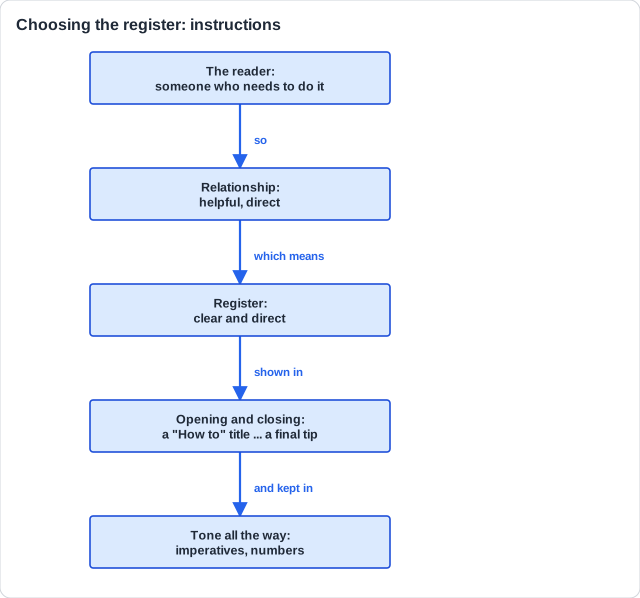
Clear and direct: Instructions use the imperative and talk to the reader as you. Keep the language precise and ordered.
Writing the steps
- Give each step with the imperative: "peel", "add", "stir".
- Address the reader directly as you.
- The reader has to follow you exactly, so use short, unambiguous sentences.
- Write one action per step.
No tentative phrases: Tentative phrases like "I think it might be nice to…" don't belong here. They weaken the command register and cost you Criterion C.
Instructions — do this
- First, peel the banana.
- Add the milk and blend for a minute.
- Be careful with the blade.
Avoid here
- I think it would be nice to peel the banana.
- Maybe you could add a little milk.
- I would be grateful if you could be careful.
Stay consistent: Keep the same command form from the first step to the last — the imperative ("peel", "add", "serve"). Don't drift into "you should peel…" or "peeling the banana…" halfway through; switching forms breaks the register.
Get feedback like a real examiner
Submit your answers and get instant feedback — what you did well, what's missing, and exactly what to write to score full marks.
The five parts: Every set of instructions follows the same shape. Hit all five parts and you have covered the conventions the examiner is looking for.
Instructions — 5 parts
Title
A clear title that says what the reader will make or do. "How to make a smoothie in five minutes."
What you need
A short intro and the things or ingredients required. "Before you start, you need a banana, milk and a blender."
Numbered steps
The steps in order, in the imperative — the longest part. "First, peel the banana. Next, add the milk."
Tip / warning
A tip or a warning so it goes well. "Be careful with the blade."
Encouraging close
A short, encouraging ending. "That's it! Give it a go."
Title → What you need → Numbered steps → Tip/warning → Encouraging close
Don't skip the frame: Students lose easy Criterion C marks by jumping straight into the steps with no title and no list of what you need. They take seconds to write and show you know the text type — never leave them out.
A model, part by part: Here is a complete set of instructions built from the five parts above. Read it once for the message, then look at how each part does its job.
Model: the 5 parts in action
The written instructions, part by part
- How to make a banana smoothie in five minutes
- This recipe is very easy and quick. Before you start, you need a ripe banana, a glass of milk, a spoonful of honey and a blender.
- First, peel the banana and cut it into pieces. Next, put the pieces in the blender and add the milk. Then, pour in the honey and blend everything for a minute. Finally, serve the smoothie in a cold glass.
- Be careful with the blender blade, and make sure you close the lid properly before you switch it on.
- That's it! You'll see it's really easy. Give it a go and tell me what you think.
A second model — homemade lemonade (part 1): How to make homemade lemonade in five minutes
This drink is easy and refreshing. Before you start, you need three lemons, cold water, sugar and a jug.
First, squeeze the lemons into the jug. Next, add the cold water and two spoonfuls of sugar. Then, stir well until the sugar dissolves. Finally, serve the lemonade with ice.
A second model — homemade lemonade (part 2)
Be careful when you squeeze the lemons, and make sure you taste it before you serve it.
That's it! You'll see it's really easy. Give it a go and make it this summer.
IB-style task — reading the conventions
One question, step by step
- The question — "What title does the text use, and what does the title tell the reader?"
- Find it in the text. The first line is the title: "How to make homemade lemonade in five minutes."
- The answer — The title "How to make homemade lemonade in five minutes" tells the reader exactly what they will make. "How to + [action]" is the standard way to open a set of instructions.
Why it scores: These short instructions earn marks on all three Paper 1 criteria — here's how:
A — Language /12
- Clear imperatives: peel, cut, put, add, pour, blend, serve
- Sequence connectors: First, Next, Then, Finally
- Precise vocabulary: banana, blender, spoonful, lid
B — Message /12
- Clear purpose: a process the reader can actually follow
- Ideas developed: ingredients, ordered steps and a warning
C — Conceptual /6
- Instructions conventions: title + what you need + steps
- Consistent command register (imperative throughout)
- An ordered, precise, direct tone
Learn what examiners really want
See exactly what to write to score full marks. Our AI shows you model answers and the key phrases examiners look for.
A toolkit you can reuse: Learn a few ready-made phrases for each part. They make your instructions sound natural and save you time in the exam.
To begin (title & what you need)
- How to + [verb]… — the standard title ("How to make a smoothie…")
- Before you start, you need… — to introduce the things required
- This recipe is easy and quick. — a short framing line
For the steps (ordering the actions)
- First,… / Next,… — to start and to move on
- Then,… / Finally,… — to continue and to close the sequence
- Make sure you… — to stress an important action
To finish (warning & close)
- Be careful with… — to give a safety warning
- That's it! You'll see it's really easy. — an upbeat close
- Give it a go. — to invite the reader to try it
| Part | A phrase you can reuse |
|---|---|
| Title | How to make homemade lemonade in five minutes |
| What you need | Before you start, you need three lemons, water and sugar. |
| A step | First, squeeze the lemons into the jug. |
| Warning / tip | Be careful when you squeeze the lemons. |
| Close | That's it! Give it a go this summer. |
Use one from each: A clear title, two or three sequence connectors in the steps, and a short encouraging close is plenty — and it instantly makes the text feel like the real text type.