What 'community' covers: Community is part of the theme Social organization. This section gives you the words for it.
You need vocabulary to…
- talk about your neighbourhood, neighbours and shared spaces
- talk about local projects and helping one another
- give your opinion about them
How to use this list: The words below are common English B vocabulary. Treat the list as a glossary: learn each term with its meaning and a synonym, then reuse them in the reading and writing sections.
- community
- a group of people who live in the same area or share something in common
- neighbourhood
- the area around where you live, and the people in it
- neighbour
- a person who lives near you
- residents' association
- an organised group of local people who work to improve the area
- public space
- an open area anyone can use — a park, a square, a community centre
- community garden
- a shared plot where local people grow plants together
- volunteering
- giving your time to help others without being paid
- to collaborate / to pull together
- to work together towards a shared goal
- to get along (with)
- to have a friendly relationship with someone
- meeting place / hub
- a spot where people gather and come together
- to lend a hand
- to help someone, often informally
- the common good
- what benefits the whole community, not just one person
- to belong / to fit in
- to feel that you are an accepted part of a group
| Useful expression | What it means |
|---|---|
| I get along really well with my neighbours. | I have a friendly relationship with the people near me. |
| My neighbourhood lacks spaces for young people. | There aren't enough places for teenagers to go. |
| I volunteer on a local project. | I give my time to help a project in my area. |
| If we all pull together, we improve the community. | Working together makes the area better for everyone. |
| I always try to lend a hand to those who need it. | I help people who need it whenever I can. |
Why this matters: This vocabulary turns up in every skill — a reading text about a local project, a listening interview with a neighbour, a Paper 1 blog or letter to the residents' association, or your oral. Reusing precise topic words is how you score Criterion A (Language).
Free preview
Reading it is one thing — hearing it is another
You're reading the free notes. Aimnova Pro unlocks the full study experience — and you can try it with your first topic free to keep:
- Audio on every wordTap any vocabulary word or example to hear it read aloud in natural English.
- FlashcardsLock in vocabulary and key terms with spaced repetition.
- Practice questionsAnswer exam-style questions and get instant AI marking.
- Mock exams & past-paper vaultSit full mocks and see exactly how examiners award marks.
- Personalised study planA daily plan built around your exam date and weak areas.
Have something to say: Examiners reward developed ideas, not just vocabulary. Take a position and back it up.
Common debates around community
- The lack of public spaces for young people.
- Do neighbours still help one another today?
- How local projects (gardens, volunteering) bring people together.
Opinion phrases (use these to introduce a view)
- In my opinion… / From my point of view… — to introduce what you think
- It seems to me that… / I believe that… — a slightly softer way to give a view
- The most important thing is… — to highlight your main point
- On the one hand… on the other hand… — to weigh up two sides
- I (completely) agree that… / I'm not convinced that… — to react to an idea
Problems in a neighbourhood
- There is a lack of public spaces where young people can meet.
- Sometimes neighbours don't know each other and nobody collaborates.
- Some shared spaces are abandoned or neglected.
A strong community
- Volunteering helps us feel part of something bigger.
- A shared project turns a neighbourhood into a meeting place.
- When neighbours pull together, everyone lives better.
Saving local places
- Small shops against online shopping
- A library that may close
- Restoring a historic landmark
New shared spaces
- A community garden on unused land
- A library of things: borrow, do not buy
- Groups where neighbours give things away
Looking after each other
- Lonely older neighbours
- Volunteers who repair, teach, cook
- Living together: cohousing
- the high street
- the main shopping street of a town
- to raise funds
- to collect money for a project
- a local council
- the group of people elected to run a town or city
- to volunteer
- to work without being paid, to help others
- isolated
- alone and without much contact with other people
- to restore
- to repair something old so it looks or works as it used to
Link your ideas: Connectors lift your answer from a list into an argument: moreover (to add), however (to contrast), therefore (to conclude), although (to concede). Use at least two or three in any written answer.
Stop wasting time on topics you know
Our AI identifies your weak areas and focuses your study time where it matters. No more overstudying easy topics.
Read like Paper 2: Here is a short blog post — the kind of text Paper 2 (Reading) gives you. Read it once just for the general idea; don't worry about every word. Then we'll work through one exam question together.
The day our street became a neighbourhood (part 1): For years I lived on a street where nobody said hello. We all hurried past one another, and I didn't even know the names of the people next door.
The day our street became a neighbourhood (part 2)
Last June, two neighbours asked the council to close our street to traffic for one Sunday afternoon. Every family brought a dish from home, the children drew with chalk on the road, and the quiet old man from number twelve turned out to be a brilliant jazz pianist.
The day our street became a neighbourhood (part 3)
Since that day we have had a group chat: people lend each other tools, water each other's plants during the holidays and look out for the older residents. I have learned that a community doesn't need a big project to begin — sometimes it only needs one afternoon together.
- to hurry past (someone)
- to walk quickly by someone without stopping
- to close a street to traffic
- to stop cars from using a street for a time
- to turn out to be
- to be discovered to be something you did not expect
- to lend
- to give something to someone for a short time
- to look out for (someone)
- to keep an eye on someone and help them if needed
IB-style task — one Paper 2 question
One question, step by step
- The question — "According to the text, what did the two neighbours ask the council to do?"
- Find it in the text. Look for the word "council": "two neighbours asked the council to close our street to traffic for one Sunday afternoon."
- The answer — To close the street to traffic for one Sunday afternoon. The words are right there in the text, so no outside knowledge is needed.
Reading technique: For an "according to the text" question, find the exact line that proves your answer — don't rely on memory or general knowledge.
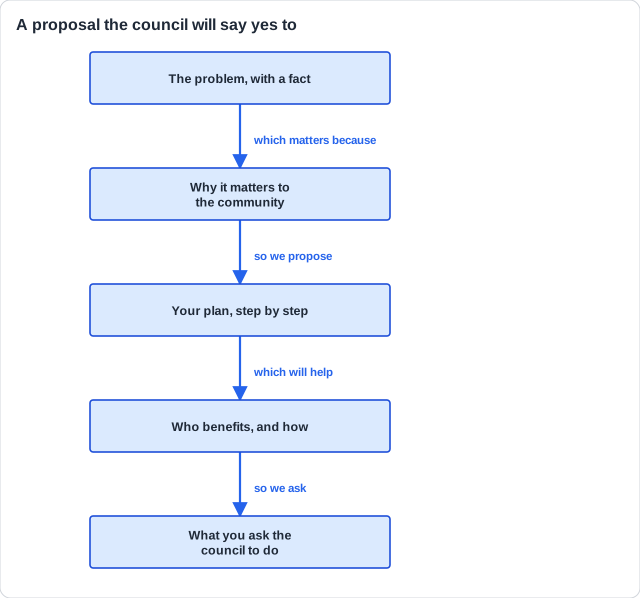
The task: Your neighbourhood's residents' association is asking young people for ideas to improve the community. Write a proposal to the association: present a local project and explain why it would help.
Write 450–600 words.
Proposal structure — 3 steps
Heading and purpose
To, From, and what you propose, in one line. "Proposal: a sharing shelf. To: … From: … Purpose: …"
The plan
How it would work: who, what, when. "We would put up a shelf in the corner shop…"
Justification
Why it is worth doing, then ask for approval. "It costs almost nothing… I therefore ask the association to approve…"
Purpose → Plan → Justification
Model: the 3 steps in ~100 words
The proposal, step by step
- Proposal: a sharing shelf in the corner shop. To: the Residents' Association. From: Marta Lopez, youth representative. Purpose: to help neighbours get to know each other and waste less.
- The plan. We would put up a shelf in the corner shop where people leave books, tools and toys they no longer need, and take what they can use. Two young volunteers would check it every week.
- Why it would work. It costs almost nothing, it reduces waste and it gives young people a role in the community. We will ask users to look after the shared spaces as if they were their own home. I therefore ask the association to approve the project at its next meeting.
Why it works: A strong proposal does this for each of the three Paper 1 criteria:
A — Language /12
- Range of forms: conditional "we would put up", future "we will ask", "as if they were"
- Connectors: "and", "therefore"
- Topic vocabulary: neighbours, volunteers, reduce waste
B — Message /12
- Task fully done: presents the project AND explains why it would help
- A concrete plan: what, who, when
C — Conceptual /6
- Proposal conventions: To / From / Purpose heading
- Plan and justification under bold headings
- A formal request for approval
Ready to ace Community?
You've seen the preview. Here's what you'll unlock:
Bite-Sized Study Notes
Full syllabus broken into chunks that stick
Exam Practice
See exactly how to score full marks
AI Feedback
Know exactly what examiners want
Smart Study Plan
Know exactly what to study next