What 'social relationships' covers: Social relationships is part of the theme Social organization. This section gives you the words for it.
You need vocabulary to…
- talk about family and friends
- talk about getting on (or not getting on) with people, trust and conflict
- talk about the bonds between different generations
- give your opinion about them
How to use this list: The words below are common English B vocabulary. Treat the list as a glossary: learn each term with its meaning and a synonym, then reuse them in the reading and writing sections.
- relationship
- the way two or more people are connected and behave towards each other
- friendship
- a close, friendly bond between people who are not family
- to get on (well) with someone
- to have a good, friendly relationship with them
- trust
- the belief that someone is honest and will not let you down
- to support / to back someone up
- to help and encourage someone, especially in difficult times
- to argue / an argument
- to disagree angrily — the disagreement itself
- conflict
- a serious disagreement or clash between people
- to make up / to make peace
- to become friends again after an argument
- the generation gap
- the difference in attitudes between younger and older people
- to spend time together
- to be with someone and share activities
- close (to someone)
- having a strong, affectionate bond with someone
- to fall out (with someone)
- to stop being friends after a disagreement
- loyal — loyalty
- always supporting your friends — the quality of being loyal
| Useful expression | What it means |
|---|---|
| I get on really well with my brother. | We have a good, friendly relationship. |
| There's a lot of trust between us. | We rely on and believe in each other. |
| We never let an argument last more than a day. | We make up quickly after disagreements. |
| My friends always back me up. | They support me when I need it. |
| There's a bit of a generation gap with my grandparents. | We see some things very differently because of our ages. |
Why this matters: This vocabulary turns up in every skill — a reading text about families, a listening clip about friends, a Paper 1 blog about a celebration, or your oral. Reusing precise topic words is how you score Criterion A (Language).
Free preview
Reading it is one thing — hearing it is another
You're reading the free notes. Aimnova Pro unlocks the full study experience — and you can try it with your first topic free to keep:
- Audio on every wordTap any vocabulary word or example to hear it read aloud in natural English.
- FlashcardsLock in vocabulary and key terms with spaced repetition.
- Practice questionsAnswer exam-style questions and get instant AI marking.
- Mock exams & past-paper vaultSit full mocks and see exactly how examiners award marks.
- Personalised study planA daily plan built around your exam date and weak areas.
Have something to say: Examiners reward developed ideas, not just vocabulary. Around social relationships, the common debates are: family vs friends, whether online friendships are as real as face-to-face ones, and how to keep a relationship healthy. Take a position and back it up.
Opinion phrases (use these to introduce a view)
- In my opinion… / From my point of view… — to introduce what you think
- It seems to me that… / I believe that… — a slightly softer way to give a view
- The most important thing is… — to highlight your main point
- On the one hand… on the other hand… — to weigh up two sides
- I (completely) agree that… / I'm not convinced that… — to react to an idea
Online friendships — drawbacks
- Less real, face-to-face contact with people.
- Misunderstandings are easy when you only text.
- It's easy to depend too much on your phone.
Online friendships — benefits
- You can stay in touch with friends far away.
- It's easy to meet people who share your interests.
- You can talk to your friends at any time of day.
When things go wrong
- Upsetting a friend, falling out over plans
- Saying sorry and finding a compromise
- Peer pressure and gossip
Staying close
- Friends and family who live far away
- Online or face-to-face friendships?
- Family events versus school duties
Bringing people together
- Being a buddy to a new or exchange student
- Young and old: home-sharing, care homes
- Loneliness at any age
- to fall out (with)
- to stop being friends after an argument
- to make up
- to become friends again after an argument
- a compromise
- an agreement where each person gives up part of what they wanted
- peer pressure
- pressure from people your age to behave as they do
- to keep in touch
- to continue to contact someone, for example by calls or messages
- a confidant
- a person you trust with your secrets and problems
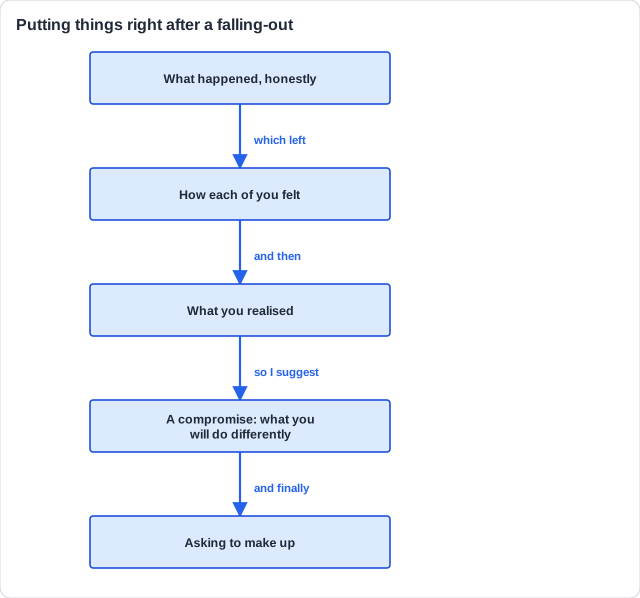
Link your ideas: Connectors lift your answer from a list into an argument: moreover (to add), however (to contrast), therefore (to conclude), although (to concede). Use at least two or three in any written answer.
Memorize terms 3x faster
Smart flashcards show you cards right before you forget them. Perfect for definitions and key concepts.
Read like Paper 2: Here is a short blog post — the kind of text Paper 2 (Reading) gives you. Read it once just for the general idea; don't worry about every word. Then we'll work through one exam question together.
Sundays with my grandmother (1 of 2): Every Sunday I visit my grandmother Carmen. When I was little we barely spoke, but now we are great friends.
At first we each did our own thing: I just stared at my phone and she watched television. One Sunday I suggested we cook her favourite recipe together, and everything changed.
Sundays with my grandmother (2 of 2)
Now she teaches me old family recipes and I show her how to make video calls with my cousins. I have realised that older people have so much to tell us, and that listening to them is worth it. Looking after that relationship makes me feel close to her and genuinely happy.
- to barely speak
- to hardly speak at all; to speak very little
- to do your own thing
- to act separately, each on your own
- to suggest
- to put forward an idea for others to consider
- to realise
- to become aware of something you hadn't noticed
- worth it
- good enough to justify the time or effort
IB-style task — one Paper 2 question
One question, step by step
- The question — "According to the text, what did the writer suggest one Sunday?"
- Find it in the text. Look for the words "One Sunday": "One Sunday I suggested we cook her favourite recipe together, and everything changed."
- The answer — She suggested they cook her grandmother's favourite recipe together. The words are right there in the text, so no outside knowledge is needed.
Reading technique: For an "according to the text" question, find the exact line that proves your answer — don't rely on memory or general knowledge.
The task: Your best friend Leo is finishing school and you want to organise a surprise party. Write an email to your group of friends: explain the idea and share out the jobs.
Write 450–600 words.
Informal email structure — 6 steps
Subject line
A short, friendly subject. "Subject: Surprise party for Leo — top secret!"
Friendly greeting
Hi + the names of your friends. "Hi everyone,"
Body: the news or the plan
Say why you are writing and give the details. "My idea is a picnic in the park on Saturday."
Your request
Ask your friends to do something, by a set day. "Can you reply by Wednesday…?"
Friendly close
A warm closing line. "Can't wait to see you all there."
Sign-off and name
Love, See you soon, or Bye for now + your first name. "Love, Maya"
Subject → Greeting → Body → Request → Friendly close → Name
Model: the 6 steps in ~100 words
The email, step by step
- Subject: Surprise party for Leo — top secret!
- Hi everyone,
- Our friend finishes school next week, so let's throw Leo a surprise party he'll never forget. He has always been there for us, and now it's our turn. My idea is a picnic in the park on Saturday afternoon.
- Can you reply by Wednesday and say what you'll bring? Sam, could you do the music? Ana and Tom, food and drinks? And please keep it a secret — not a word to Leo!
- Can't wait to see you all there.
- Love, Maya
Why it works: A strong informal email does this for each of the three Paper 1 criteria:
A — Language /12
- Range of tenses: present perfect "he has always been", future "you'll bring", "let's"
- Connectors: "so", "and now"
- Topic vocabulary: surprise party, picnic, keep it a secret
B — Message /12
- Task fully done: explains the idea AND shares out the jobs
- A clear request with a deadline
C — Conceptual /6
- Email conventions: subject line, "Hi everyone", "Love, Maya"
- Informal register with contractions, right for friends
- Questions that ask each friend to act
Ready to ace Social relationships?
You've seen the preview. Here's what you'll unlock:
Bite-Sized Study Notes
Full syllabus broken into chunks that stick
Exam Practice
See exactly how to score full marks
AI Feedback
Know exactly what examiners want
Smart Study Plan
Know exactly what to study next