What 'technology' covers: Technology is part of the theme Human ingenuity. This section gives you the words for it.
You need vocabulary to…
- talk about devices, the internet, social media, apps and artificial intelligence
- talk about how technology shapes work and daily life
- give your opinion about them
How to use this list: The words below are common English B vocabulary. Treat the list as a glossary: learn each term with its meaning and a synonym, then reuse them in the reading and writing sections.
- device / gadget
- a piece of equipment such as a phone, tablet or laptop
- screen
- the flat surface of a phone, computer or TV that shows images
- app (application)
- a program you run on a phone or computer to do a task
- social media
- online platforms where people share posts and messages
- to browse the internet
- to look at different websites, often without a fixed goal
- artificial intelligence (AI)
- computer systems that can do tasks that normally need human thinking
- to code / coding
- to write the instructions (programs) that make software work
- tool
- something you use to do a job; here, technology used for a purpose
- to be connected / online
- to be linked to the internet and reachable by others
- to rely on / depend on technology
- to need technology in order to do everyday things
- screen time
- the amount of time you spend looking at a screen each day
- to switch off / unplug
- to stop using screens and take a break
- to use technology sensibly
- to use it in a careful, balanced and responsible way
| Useful expression | What it means |
|---|---|
| I spend too much time in front of a screen. | My daily screen time is higher than it should be. |
| I can't live without my phone. | I feel I depend on my phone a great deal. |
| I use an app to organise my studies. | A program helps me plan and keep track of my work. |
| Artificial intelligence is everywhere. | AI is now part of many everyday products and services. |
| You have to use technology sensibly. | You should use it in a careful, balanced way. |
Why this matters: This vocabulary turns up in every skill — a reading text about social media, a listening interview about a phone ban, a Paper 1 blog about apps, or your oral. Reusing precise topic words is how you score Criterion A (Language).
Free preview
Reading it is one thing — hearing it is another
You're reading the free notes. Aimnova Pro unlocks the full study experience — and you can try it with your first topic free to keep:
- Audio on every wordTap any vocabulary word or example to hear it read aloud in natural English.
- FlashcardsLock in vocabulary and key terms with spaced repetition.
- Practice questionsAnswer exam-style questions and get instant AI marking.
- Mock exams & past-paper vaultSit full mocks and see exactly how examiners award marks.
- Personalised study planA daily plan built around your exam date and weak areas.
Have something to say: Examiners reward developed ideas, not just vocabulary. Take a position and back it up.
Common debates around technology
- Too much screen time vs staying connected.
- Does social media help or harm?
- Will robots and AI destroy jobs or create them?
Opinion phrases (use these to introduce a view)
- In my opinion… / From my point of view… — to introduce what you think
- It seems to me that… / I believe that… — a slightly softer way to give a view
- The most important thing is… — to highlight your main point
- On the one hand… on the other hand… — to weigh up two sides
- I (completely) agree that… / I'm not convinced that… — to react to an idea
Drawbacks of technology
- We spend too much time hooked on screens.
- Social media can affect our self-esteem and our sleep.
- Some people fear that robots will take their jobs away.
Benefits
- Technology connects us with people all over the world.
- Apps help us study and stay organised.
- Artificial intelligence also creates new kinds of jobs.
Technology at school
- Apps for schoolwork: helpful or distracting?
- Notes on a laptop or with a pen
- Old equipment, AI tools, virtual visits
Technology in daily life
- Translation and language-learning apps
- Augmented and virtual reality
- Drones, delivery robots, driverless cars
Risks and rules
- Your digital footprint lasts for ever
- Cyber security and online fraud
- Asking permission, AI that is unfair
- a digital footprint
- everything you post or do online, which others can find later
- cyber security
- protecting computers, accounts and data from attacks
- artificial intelligence (AI)
- computer systems that do tasks that normally need human thinking
- augmented reality (AR)
- digital images added to the real world on a screen
- bias (in AI)
- unfair results because the data the system learned from was incomplete
- outdated
- old and no longer good enough for what is needed today
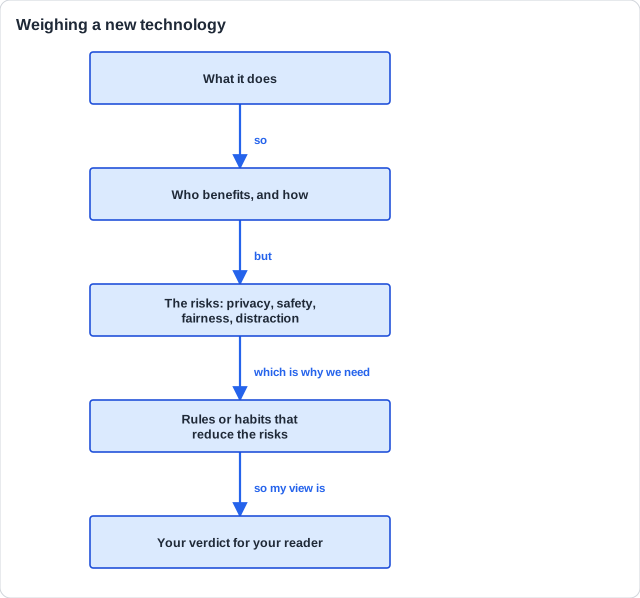
Link your ideas: Connectors lift your answer from a list into an argument: moreover (to add), however (to contrast), therefore (to conclude), although (to concede). Use at least two or three in any written answer.
Learn what examiners really want
See exactly what to write to score full marks. Our AI shows you model answers and the key phrases examiners look for.
Read like Paper 2: Here is a short blog post — the kind of text Paper 2 (Reading) gives you. Read it once just for the general idea; don't worry about every word. Then we'll work through one exam question together.
My uncle's shop goes online (1 of 2): Last spring my uncle told me that his small bike shop was losing customers, because people now compared prices and booked repairs on the internet. He had never used a computer for work, so I offered to help.
I had no idea how to build a website, but I learned everything from free online videos. It took me three weekends.
My uncle's shop goes online (2 of 2)
I added photos of the bikes, a price list and a simple form for booking repairs. Within two months, half of his bookings were arriving through the website. I realised that technology doesn't only replace small businesses — it can also help them survive. Next year I want to learn programming properly.
- to lose customers
- to have fewer and fewer people buying from you
- to compare prices
- to look at what different shops charge before you buy
- to book (a repair)
- to arrange in advance for something to be done
- within (two months)
- before (two months) have passed
- to survive
- to continue to exist despite difficulties
IB-style task — one Paper 2 question
One question, step by step
- The question — "According to the text, how did the writer learn to build the website?"
- Find it in the text. Look for the word "learned": "I had no idea how to build a website, but I learned everything from free online videos."
- The answer — From free online videos. The words are right there in the text, so no outside knowledge is needed.
Reading technique: For an "according to the text" question, find the exact line that proves your answer — don't rely on memory or general knowledge.
The task: Your school is running a technology-and-the-future week. Write an opinion column for the school newspaper: give your view on whether technology helps or harms young people and say how it should be used.
Write 450–600 words.
Opinion column structure — 5 steps
Headline
A short, punchy headline that shows your view. "Stop blaming the screen"
Your position
Say what you think in the first lines. "In my view, the problem is how we use it."
Arguments
Back it up with reasons and an example. "I used to spend the whole day on my phone…"
Answer the other side
Some people say… However… "Some people say… However…"
Conclusion
Finish with a firm final line. "It's up to us to use it well."
Headline → Position → Arguments → Rebuttal → Conclusion
Model: the 5 steps in ~100 words
The opinion column, step by step
- Stop blaming the screen
- Technology does not ruin our lives. In my view, the problem is how we use it.
- I used to spend the whole day on my phone and barely spoke to my family. Then I took a coding course and saw the other side: technology can be creative and useful. Learn to code so you don't get left behind.
- Some people say we should ban phones at school. However, a ban teaches us nothing; learning to switch off for a while every day teaches us a lot.
- Technology is just a tool, and it's up to us to use it well.
Why it works: A strong opinion column does this for each of the three Paper 1 criteria:
A — Language /12
- Range of tenses: past "I used to spend", "I took", modal "we should"
- Connectors: "in my view", "then", "however"
- Topic vocabulary: coding, ban, switch off
B — Message /12
- Task fully done: gives a clear view AND says how to use technology
- Arguments backed by a personal example
C — Conceptual /6
- Column conventions: a punchy headline that shows the view
- A clear position in the first lines
- Answers the other side: "Some people say… However…"
Ready to ace Technology?
You've seen the preview. Here's what you'll unlock:
Bite-Sized Study Notes
Full syllabus broken into chunks that stick
Exam Practice
See exactly how to score full marks
AI Feedback
Know exactly what examiners want
Smart Study Plan
Know exactly what to study next