What 'communication & media' covers: Communication & media is part of the theme Human ingenuity. This section gives you the words for it.
You need vocabulary to…
- talk about the news, the press, social media and apps
- talk about how we get informed
- give your opinion about them
How to use this list: The words below are common English B vocabulary. Treat the list as a glossary: learn each term with its meaning and a synonym, then reuse them in the reading and writing sections.
- the media
- the press, TV, radio and online platforms that share news and information
- the news
- reports of recent events, in print, on screen or online
- the press (digital / print)
- newspapers and magazines, whether online or on paper
- a journalist
- a person who researches and reports the news
- social media
- online platforms where people post and share content with others
- to get informed (about)
- to find out what is happening; to keep up with the news
- to share a post
- to forward a message or article to other people online
- to check the information / source
- to make sure a claim is true and comes from a reliable place
- a (reliable) source
- the place a piece of information comes from
- fake news
- false or misleading stories presented as if they were real news
- a headline
- the title of a news story, printed in large type
- freedom of the press
- the right of the media to report without censorship
- a screen
- the display of a phone, tablet, computer or TV
| Useful expression | What it means |
|---|---|
| I get my news from the internet. | I find out what's happening mostly online. |
| I follow several journalists on social media. | I read the posts of reporters I trust online. |
| Before sharing, I check the source. | I make sure it's reliable before forwarding it. |
| I spend too much time looking at posts. | I scroll through social media more than I should. |
| You have to be careful with fake news. | False stories spread easily, so stay alert. |
Why this matters: This vocabulary turns up in every skill — a reading text about the press, a listening interview with a journalist, a Paper 1 blog about social media, or your oral. Reusing precise topic words is how you score Criterion A (Language).
Free preview
Reading it is one thing — hearing it is another
You're reading the free notes. Aimnova Pro unlocks the full study experience — and you can try it with your first topic free to keep:
- Audio on every wordTap any vocabulary word or example to hear it read aloud in natural English.
- FlashcardsLock in vocabulary and key terms with spaced repetition.
- Practice questionsAnswer exam-style questions and get instant AI marking.
- Mock exams & past-paper vaultSit full mocks and see exactly how examiners award marks.
- Personalised study planA daily plan built around your exam date and weak areas.
Have something to say: Examiners reward developed ideas, not just vocabulary. Take a position and back it up.
Common debates around the media
- Social media vs the traditional press.
- Online news vs print.
- The danger of fake news vs free, instant information.
Opinion phrases (use these to introduce a view)
- In my opinion… / From my point of view… — to introduce what you think
- It seems to me that… / I believe that… — a slightly softer way to give a view
- The most important thing is… — to highlight your main point
- On the one hand… on the other hand… — to weigh up two sides
- I (completely) agree that… / I'm not convinced that… — to react to an idea
Risks of social media
- A lot of fake news spreads without being checked.
- We spend hours looking at posts and get distracted.
- We don't always know who is behind the information.
Benefits of getting informed online
- We can get informed instantly and from anywhere.
- We have access to many sources and points of view.
- Social media gives a voice to independent journalists.
News and truth
- Fake news: why it spreads so fast
- Judging a source: blog, newspaper, post
- Young journalists and their competitions
Life online
- Influencers: how they grow a following
- Algorithms that choose your feed
- Emojis and selfies as a new language
Staying safe
- Cyberbullying: what happened, its effects, what to do
- A social media safety workshop
- A video or film that made you think
- a reliable source
- a person or website you can trust to give correct information
- to go viral
- to spread very fast online and be seen by huge numbers of people
- an algorithm
- a set of computer rules that decides, for example, what you see in your feed
- cyberbullying
- using messages or posts to hurt, threaten or embarrass someone
- an influencer
- a person with many online followers whom brands pay to promote products
- to fact-check
- to check whether information is true before believing or sharing it
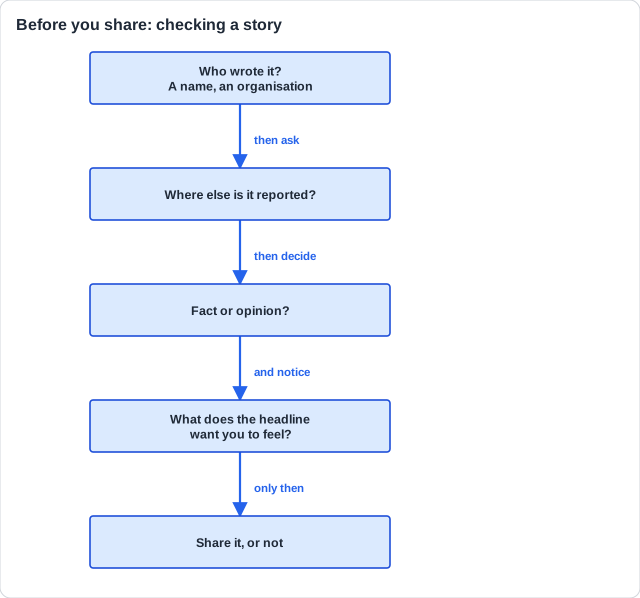
Link your ideas: Connectors lift your answer from a list into an argument: moreover (to add), however (to contrast), therefore (to conclude), although (to concede). Use at least two or three in any written answer.
Learn what examiners really want
See exactly what to write to score full marks. Our AI shows you model answers and the key phrases examiners look for.
Read like Paper 2: Here is a short blog post — the kind of text Paper 2 (Reading) gives you. Read it once just for the general idea; don't worry about every word. Then we'll work through one exam question together.
Should we ban phones at school? (1 of 2): At my school there is a proposal to ban phones completely, and I don't agree.
It's true that many classmates spend too much time on social media and get distracted in class. However, the phone is also a tool: with it I look up information, read the news in the morning and keep in touch with my family.
Should we ban phones at school? (2 of 2)
Instead of banning it, we should learn to use it responsibly. That's why I suggest switching the phone off during lessons but leaving it free at break times. Banning it altogether teaches us nothing; using it well does.
- to ban
- to officially forbid something
- to get distracted
- to lose your focus and pay attention to something else
- a tool
- something you use to do a useful job
- break time
- the short rest between lessons at school
- responsibly
- in a sensible, careful way
IB-style task — one Paper 2 question
One question, step by step
- The question — "According to the text, what does the writer suggest instead of banning the phone altogether?"
- Find it in the text. Look for the word "suggest": "That's why I suggest switching the phone off during lessons but leaving it free at break times."
- The answer — They suggest switching the phone off during lessons but leaving it free at break times. The words are right there in the text, so no outside knowledge is needed.
Reading technique: For an "according to the text" question, find the exact line that proves your answer — don't rely on memory or general knowledge.
The task: Your school is running a week on the responsible use of technology. Write a blog post for other students: describe how you get informed and use social media and give advice for using the media in a more critical way.
Write 450–600 words.
Blog structure — 5 steps
Catchy title
A title, often a question. "Ban the phone or learn to use it?"
Greeting + topic
Greet the reader and say what the post is about. "Hi everyone! Today I want to talk about the media…"
Your experience
Describe your old habits in the past. "I used to believe everything I saw online…"
Two or three tips
Give advice using imperatives. "Check the news against several sources", "follow serious journalists", "take a break from screens".
Motivating close
Finish with an encouraging line. "Start getting better informed today — you'll make a difference."
Title → Greeting → Experience → Tips → Close
Model: the 5 steps in ~100 words
The blog post, step by step
- Ban the phone or learn to use it? I'm clear about it.
- Hi everyone! I'm Marta, and today I want to talk about something that affects us all: the media.
- I used to believe everything I saw online and shared news without checking it. I spent hours on social media without thinking about what I was reading.
- So here are three tips. First, check the news against several sources. Second, follow serious journalists. And third, take a break from screens for a while every day.
- The most important thing, though, is to be critical about what we read. Start getting better informed this week and you'll make a real difference.
Why it works: A strong blog post does this for each of the three Paper 1 criteria:
A — Language /12
- Range of tenses: past "I used to", imperatives "check", "follow"
- Connectors: "so", "though", "first/second/third"
- Topic vocabulary, used accurately
B — Message /12
- Task fully done: describes media habits AND gives advice
- Ideas developed with concrete examples
C — Conceptual /6
- Blog conventions: a catchy title
- Direct address: "Hi everyone", "you'll make a difference"
- A persuasive, personal tone
Ready to ace Communication & media?
You've seen the preview. Here's what you'll unlock:
Bite-Sized Study Notes
Full syllabus broken into chunks that stick
Exam Practice
See exactly how to score full marks
AI Feedback
Know exactly what examiners want
Smart Study Plan
Know exactly what to study next