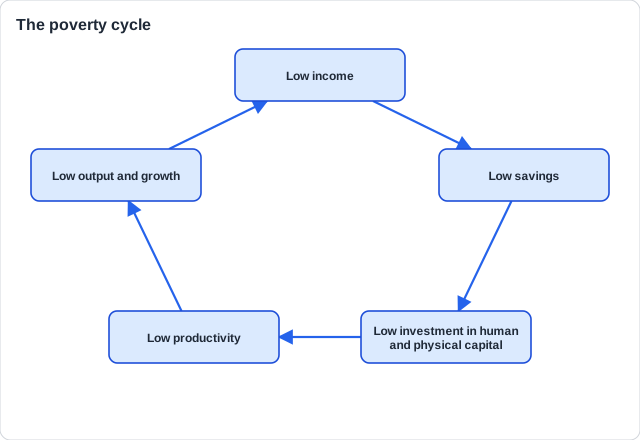
A poverty cycle (or poverty trap) is when low income keeps savings and investment low, so productivity and income stay low. Poverty passes from parents to children.
The points to remember
- Start and end the cycle with low income.
- Always include low investment in human or physical capital: a cycle without it scores nothing.
Free preview
This is the free notes preview
You're reading the free notes. Aimnova Pro unlocks the full study experience — and you can try it with your first topic free to keep:
- FlashcardsLock in vocabulary and key terms with spaced repetition.
- Practice questionsAnswer exam-style questions and get instant AI marking.
- Mock exams & past-paper vaultSit full mocks and see exactly how examiners award marks.
- Personalised study planA daily plan built around your exam date and weak areas.
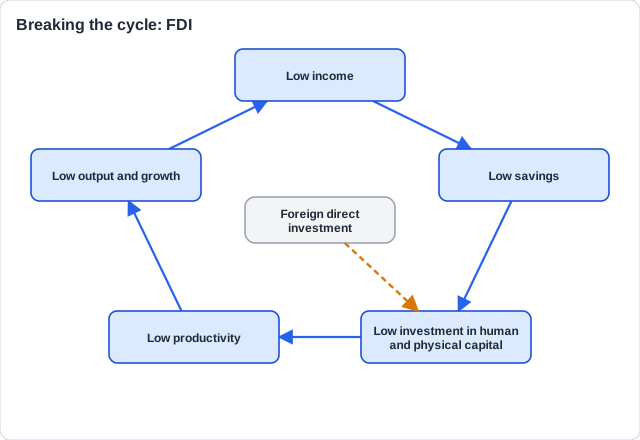
A policy breaks the cycle by raising one link in the chain. Show where it enters with an arrow.
Where policies break the cycle
| Policy | Where it enters | Why the cycle breaks |
|---|---|---|
| Free schooling, girls' education | Investment in human capital | Skills raise productivity |
| Clinics, clean water | Investment in human capital | Healthier workers produce more |
| Foreign direct investment (FDI) | Investment in physical capital | Factories, jobs, technology |
| Aid for roads and power | Investment in physical capital | Lower costs, new markets |
| Cash transfers, remittances | Income | Families can save and keep children in school |
| Microcredit | Savings and investment | Small loans start small firms |
See how examiners mark answers
Answer exam-style questions with model answers. Learn exactly what earns marks and what doesn't.
Paper 2 asks this almost every year, for 4 marks: free schooling (May 2022), FDI (specimen), better education (November 2025) and cash transfers (May 2026).
Text E says that Malandi's government has made primary and secondary schooling free.
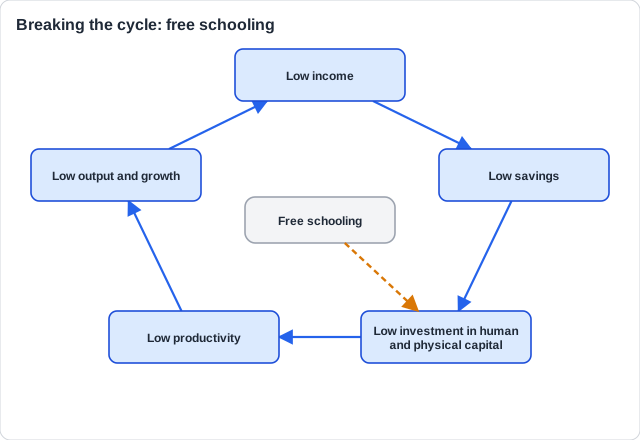
Using a poverty cycle diagram, explain how free schooling may help households break the poverty cycle.
Model answer plan
See the answer broken into clear points, with guidance on how each point earns marks.
How the 4 marks are given
| Marks | What your answer needs |
|---|---|
| 3–4 | A correct diagram and a correct explanation |
| 1–2 | A correct diagram or a correct explanation, not both |
| 3 at most | A diagram with a wrong or missing label |