Start here: Questions on this topic ask you to apply the three needs and place motivation on the continuum. Name the need or the type each time, with the clue from the athlete.
1. Self-determination theory
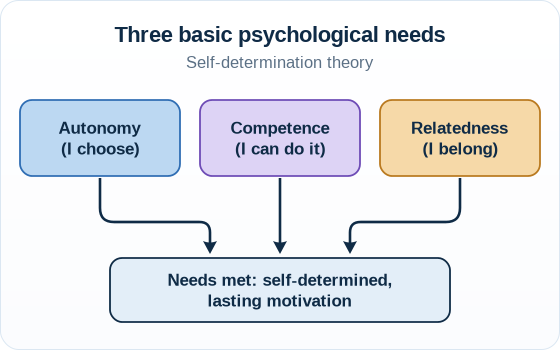
- Three needs: autonomy, competence, relatedness.
- All three met: self-determined, lasting motivation.
- Rate each need separately: one can be high while another is low.
2. The motivation continuum
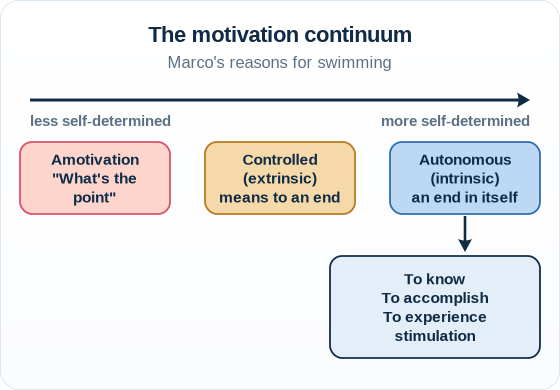
- Amotivation: no link seen between effort and outcome.
- Controlled (extrinsic): a means to an end.
- Autonomous (intrinsic): an end in itself; to know, to accomplish, to experience stimulation.
- Intrinsic: enjoyment, persistence; extrinsic: more anxiety.
Three needs feeding self-determined motivation.
The motivation continuum.
Key terms, one line each:
| Term | In one line |
|---|---|
| Autonomy | feeling in control of your own actions |
| Competence | feeling able to do the task well |
| Relatedness | feeling connected to others |
| Amotivation | no link seen between effort and outcome |
IB-style questionExplain[3 marks]
A coach lets players choose drills, praises skill progress and runs team socials. Explain the effect using self-determination theory.
Model answer plan
See the mark-by-mark plan — for / against / judgement, with marking guidance — in study mode.
Exam tips
- The three needs: autonomy, competence, relatedness.
- Always name the need the point is about.
- Order the continuum: amotivation, controlled, autonomous.
- Controlled = means to an end; autonomous = end in itself.