aımnova
DashboardMy LearningCrash CoursesStudy Plan

Aimnova site navigation

Stay in the loop

Get the latest study resources and updates

New features, study tips and exam insights — straight to your inbox.

IB Diploma

  • IB Past Papers
  • IB Study Notes
  • IB Question Bank
  • IB Mock Exams
  • IB Revision

IB Subjects

  • IB Math AA
  • IB Math AI
  • IB Economics
  • IB Business Management
  • IB Physics
  • IB Biology
  • View all IB subjects→

IB Past Papers

  • IB Math AA HL Past Papers
  • IB Math AA SL Past Papers
  • IB Math AI HL Past Papers
  • IB Math AI SL Past Papers
  • IB Economics HL Past Papers
  • IB Economics SL Past Papers
  • IB ESS Past Papers
  • View all past papers→

Study Resources

  • Study Notes
  • Question Bank
  • Mock Exams
  • Crash Courses
  • Flashcards
  • Revision Guide
  • Exam Skills
  • Command Terms
  • Grade Calculator
  • Exam Timetable 2027

Aimnova

  • Features
  • Pricing
  • For Teachers
  • For Schools
  • For Parents
  • About Us
  • Blog
  • Contact
aımnova

IB study, practice and feedback built around the real exam.

TermsPrivacyCookies·© 2026 Aimnova. All rights reserved.d9e1c61

Aimnova is not affiliated with or endorsed by the International Baccalaureate Organization (IB).

NotesSports, Exercise and Health ScienceTopic 8.2
Unit 8 · Motor learning · Topic 8.2

IB Sports, Exercise and Health Science — Attentional control

Attentional control

Exam technique guidePractice questions

Key concepts in Attentional control

Start here: Questions on this topic ask you to classify attention and distractors, and how to control focus. Say internal or external and broad or narrow, with an example from the sport.

1. Four kinds of attention

  • Internal or external; broad or narrow.
  • Broad external: reading the whole field. Narrow external: the ball.
  • Broad internal: planning a strategy. Narrow internal: one cue word.

2. Losing focus

  • External distractors: visual or auditory, such as the crowd.
  • Internal distractors: negative or unrelated thoughts, such as self-doubt.
  • High arousal narrows attention: cues are missed.

3. Controlling attention

  • Controlled distraction: slow breathing, imagery of the routine, one small detail.
  • Positive self-talk and goal setting keep focus.
  • Say what each method does to attention.

The two-by-two grid of attentional focus.
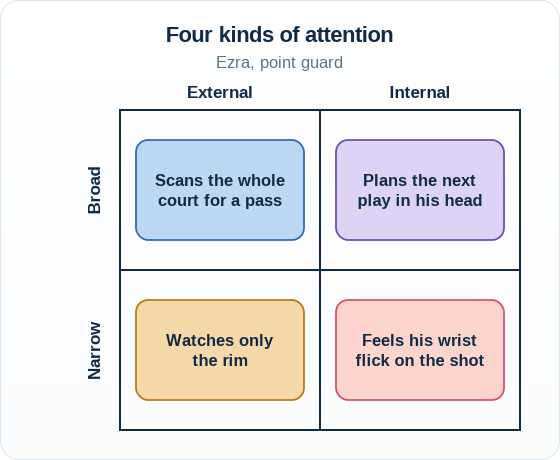
Two-by-two grid of attentional focus with basketball examples
Recap: the four kinds of attention.

Inside My Learning

Turn these notes into practice

Try each question, reveal a clear model answer, and learn how to build your response.

  • 1.Classify the attention of a quarterback planning a play in the huddle. [1]
  • 2.Outline one external and one internal distractor for a free-throw shooter. [2]
  • 3.Explain how high arousal affects attention. [2]
Claim your free topic

Key terms, one line each:

TermIn one line
Broad attentiontaking in many cues at once
Narrow attentionfocusing on one or two cues
Internal distractora thought or feeling that pulls focus
Controlled distractiona deliberate switch of focus to stay on task

Inside My Learning

Turn these notes into practice

Try each question, reveal a clear model answer, and learn how to build your response.

  • 1.Watching only the ball: which kind?
  • 2.Self-doubt is which distractor?
  • 3.Crowd noise: visual or auditory?
Claim your free topic
IB-style questionExplain[3 marks]

A golfer hears a camera click during her putt. Explain how she could regain her focus.

Model answer plan

See the mark-by-mark plan — for / against / judgement, with marking guidance — in study mode.

Claim your free topic →

Exam tips

  • For external distractors say visual or auditory, then the example.
  • Internal distractors are negative or unrelated thoughts.
  • Working out a strategy in your head is broad internal.
  • Say what each control method does to attention.

What you'll learn in Topic 8.2

  • 8.2.1 Attentional control
Suggested study order: Read the notes for each sub-topic below → test yourself with flashcards → attempt practice questions → review exam technique.

Study resources — 8.2 Attentional control

8.2.1

Attentional control

Notes

Ready to study Attentional control?

Get expert practice questions with instant AI feedback, and a study planner tailored to your IB Sports, Exercise and Health Science exam date.

Start studying free

Topic 8.2 Attentional control forms a core part of Unit 8: Motor learning in IB Sports, Exercise and Health Science. Mastering these concepts will strengthen your understanding of connected topics across the syllabus and prepare you for exam questions that require analysis, evaluation, and real-world application.

Previous topic
8.1 Motor learning processes
Next topic
9.1 Achievement motivation
All Sports, Exercise and Health Science topics
Exam technique

Ready to practice?

Get AI-graded practice questions, mock exams, flashcards, and a personalised study plan — all aligned to your IB syllabus.

Start Studying Free

No credit card required · No time limit