Studying this at HL: HL papers set these hormones in real conditions: open-water swimming in cold or warm water, hydration across the cycle, bone health in gymnasts as they age. So for each hormone, learn its effect and then what that means for an athlete in that setting.
The big idea: Progesterone, oestrogen and testosterone are the reproductive hormones. Everybody makes all three — just in very different amounts.
They also change
- How hot you get
- How you sleep
- Which fuel you burn
- How loose your joints are
- How much oxygen your blood can carry
Our example: Sofia swims a 400 m time trial every Tuesday morning. Same pool, same time, same warm-up. Her time is usually 5:12.
Some Tuesdays it is 5:20 and the effort feels worse, and nothing about her training has changed.
Her hormone levels are not the same every week, and that is enough to move the number. You do not need every detail of the cycle here. You need what each hormone does.
Each hormone and the body systems it acts on. These are the exact effects the guide names, so this is the list to know.
Interactive diagram
Explore the labelled diagram, charts and maps for this topic in full study mode.
Free preview
This is the free notes preview
You're reading the free notes. Aimnova Pro unlocks the full study experience — and you can try it with your first topic free to keep:
- FlashcardsLock in vocabulary and key terms with spaced repetition.
- Practice questionsAnswer exam-style questions and get instant AI marking.
- Mock exams & past-paper vaultSit full mocks and see exactly how examiners award marks.
- Personalised study planA daily plan built around your exam date and weak areas.
Progesterone is thermogenic, which just means it raises body temperature. Not by much — a few tenths of a degree at rest — but Sofia starts her 400 m already warmer than usual.
What progesterone does
Thermoregulation — she starts warmer
Her resting temperature sits higher, so she has less room to heat up before she is too hot. In a warm pool hall the same pace feels harder.
Sleep quality — she wakes more
Progesterone changes how well she sleeps, and a warmer body is a worse body for sleeping. Broken sleep on Monday night shows up in Tuesday's time.
Fuel availability — less is ready
It also leaves less stored carbohydrate ready to burn. For a hard 400 m, carbohydrate is the fuel she wants, so having less of it available costs her.
See it drawn, step by step
In My Learning, handwritten diagrams build one step at a time. Play, pause and replay each explanation until it clicks. Create your free account to try it.
Follicular phase (before ovulation)
- Progesterone low
- Oestrogen dominant: core temperature lower
- Heat is lost more easily
Luteal phase (after ovulation)
- Progesterone high
- Core temperature a few tenths higher
- Less blood to the skin, so heat leaves less easily
- Harder to lose heat: drink more and plan for the heat
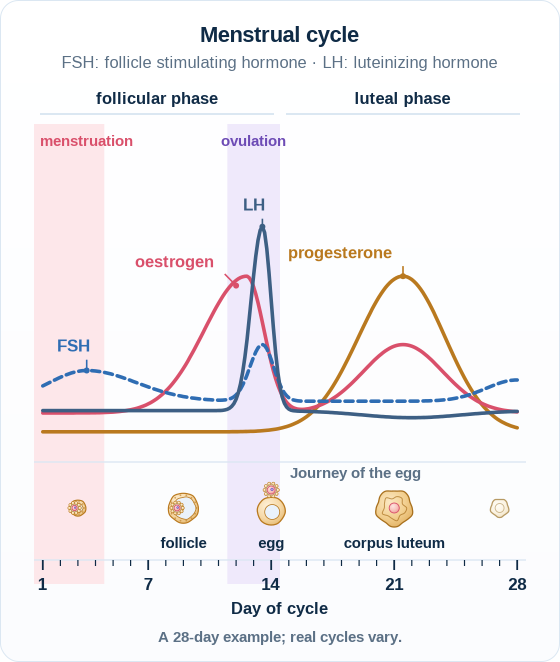
Hot day or cold water: In the heat, the luteal phase makes thermoregulation harder and fluid needs higher. In cold water it helps a little: a warmer core means less energy spent keeping warm. In the follicular phase she starts cooler, so cold water costs her more energy to stay warm.
Small temperature change, real effect: Half a degree sounds like nothing. But her body loses heat by the difference between her and the air, so starting warmer means she reaches her limit sooner.
On a hot day that is the difference between holding pace and slowing.
Study smarter, not longer
Most students waste 40% of study time on topics they already know. Our AI tracks your progress and optimizes every minute.
Glycogen is the body's stored carbohydrate, kept in the muscles and the liver. It is the fuel for hard work, and there is only so much of it.
Oestrogen spares it.
Sparing glycogen
- Pushes the body to burn more fat instead
- So the stored carbohydrate lasts longer
- Helps most in long work — a 90-minute open-water swim
- Sparing means using it slower, not making more of it
Joint stiffness
- Makes the tissue around a joint less stiff
- The joint moves further but is held less tightly
- More range of movement, less support
- A looser knee is an easier knee to injure
The two hormones pull opposite ways on fuel: Oestrogen makes stored carbohydrate last longer. Progesterone leaves less of it ready to use.
They act on the same thing — fuel availability — from opposite sides. Exam questions often swap these two round.
Sofia makes testosterone too. Her training partner Luca makes far more of it, and that is one reason the same training block builds more muscle on him.
Three effects, one direction: Its three named effects all point the same way: a body that rebuilds stronger and carries more oxygen.
What testosterone does
Bone formation — stronger bone
It drives new bone being laid down, so bones get denser and harder to break. Low testosterone over months means weaker bone and more stress fractures.
Protein synthesis — more muscle built
Protein synthesis means building new protein. In muscle, that is repairing the damage from training and adding to it, so Sofia comes back stronger than she was.
Erythropoietin — more red blood cells
Erythropoietin is the signal that tells the body to make more red blood cells. More red cells means more oxygen delivered, which is exactly what a 400 m swim runs on.
Bones, women and men: Oestrogen helps keep bone dense. After the menopause it falls, and bone is lost faster. With less testosterone as well, women carry a higher risk of weak bones later in life, and heavy training with too little food when young adds to it.
Why it matters to athletes: Build bone, build muscle, carry more oxygen. That is a list of everything an endurance or strength athlete trains for.
It is also why anything that lowers testosterone — under-eating for months, for example — shows up as weaker bone and stalled progress.
Practice with exam-style questions
Answer exam-style questions and get AI feedback that shows you exactly what examiners want to see in a full-marks response.
How this is tested — you link a reproductive hormone to its effect, then apply it to an athlete and a setting. It comes up two ways:
Paper 1 — recall and data
- Paper 1A matches testosterone or oestrogen to its named effects
Paper 2 — explain and evaluate
- Paper 2 asks you to explain how the menstrual cycle affects heat loss or fluid needs
- Or to distinguish bone risk between female and male athletes
Naming the phase but not the hormone: "In the luteal phase she is hotter" misses the link. Say progesterone is high in the luteal phase, so core temperature is higher, then say what that means in this water.
Before a cold lake swim, a triathlete's core temperature is 37.2 °C on day 22 of her cycle and 36.8 °C on day 8. Explain the difference and what it means for each swim.
Model answer plan
See the answer broken into clear points, with guidance on how each point earns marks.
Exam tips
- Luteal phase: progesterone high, core temperature up. Follicular phase: oestrogen, lower core temperature.
- Cold water: a higher core temperature helps. Warm water or heat: it makes cooling harder and fluid needs higher.
- Female bone risk as they age: less testosterone, oestrogen falls after menopause, heavy training with too little food when young.
- Testosterone: bone formation, protein synthesis, erythropoietin. Learn all three together.