The big idea: Crank a car's starter and the headlights dim for a moment — the battery can't quite hold its full voltage when a big current is drawn.
Why the lights dim: That shortfall is the cell's internal resistance at work. No real cell is perfect.
| Term | What it means |
|---|---|
| Emf (electromotive force) | the energy a cell gives to each coulomb of charge (unit: the volt, V) |
| Internal resistance r | a small resistance inside the cell that uses up some energy as current flows |
| Terminal p.d. | the voltage you actually get out — a bit less than the emf |
A real cell = emf ε with internal resistance r inside it. The same current I flows through r and the load R. The voltmeter across R reads the terminal p.d. V — what's actually delivered to the circuit.
Interactive diagram
Explore the labelled diagram, charts and maps for this topic in full study mode.
Spot it: Think of a cell as a perfect battery (emf ε) with a tiny resistor r built in.
The same current flows through both r and the outside circuit, so r quietly 'steals' some volts.
Every cell is a source of emf: it does work on each coulomb of charge, changing another form of energy into electrical energy.
| Source of emf | Energy changed | For | Against |
|---|---|---|---|
| Chemical cell (battery) | chemical → electrical | portable; steady emf; rechargeable types can be reused | runs down; limited energy; disposal and mining harm the environment |
| Solar cell | light → electrical | no fuel and no emissions while running; long life | output depends on light, nothing at night; low emf per cell, so many are needed |
Free preview
This is the free notes preview
You're reading the free notes. Aimnova Pro unlocks the full study experience — and you can try it with your first topic free to keep:
- FlashcardsLock in vocabulary and key terms with spaced repetition.
- Practice questionsAnswer exam-style questions and get instant AI marking.
- Mock exams & past-paper vaultSit full mocks and see exactly how examiners award marks.
- Personalised study planA daily plan built around your exam date and weak areas.
The emf has to push current through everything — the outside load R and the internal resistance r. Adding the two resistances together gives the data-booklet equation:
- emf of the cell (V) — the energy it gives each coulomb
- current in the circuit (A)
- external (load) resistance (Ω)
- internal resistance of the cell (Ω)
Multiply out the bracket: ε = IR + Ir. The part IR is the voltage across the load — the terminal p.d. you actually use. Rearranging gives:
- terminal p.d. — voltage across the cell's terminals (V)
- emf of the cell (V)
- current in the circuit (A)
- internal resistance of the cell (Ω)
Two things to get right: 1. The lost volts are Ir — the volts used up inside the cell. They grow as the current grows.
2. The terminal p.d. V is what a voltmeter across the cell reads, and it equals IR (the volts across the load).
A cell of emf 1.5 V has an internal resistance of 0.50 Ω. It drives a current of 0.40 A through a circuit. Find the terminal p.d. across the cell.
Model answer plan
See the answer broken into clear points, with guidance on how each point earns marks.
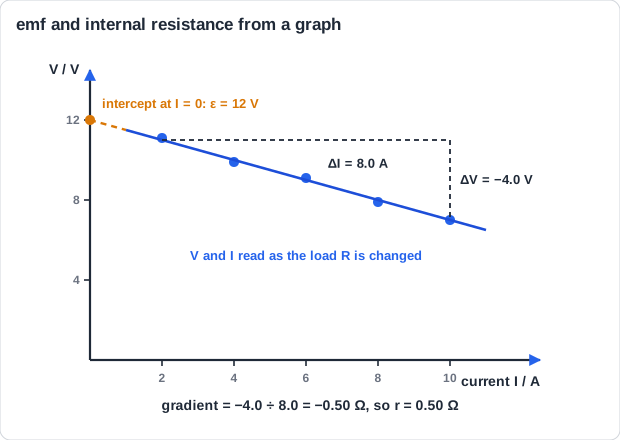
Why the terminal pd changes with the load: Lower the load resistance R and the current I rises. The lost volts Ir rise with it, so the terminal pd V = ε − Ir falls. Raise R and V climbs back towards ε.
Finding ε and r from a graph
Know your predicted grade
Take timed mock exams and get detailed feedback on every answer. See exactly where you're losing marks.
How this is tested — internal resistance turns the simple V = IR circuit into a two-resistor problem (R outside, r inside):
Paper 1A
- Why the terminal p.d. drops when more current is drawn.
- The special case r ≈ 0 (terminal p.d. ≈ emf).
Paper 2
- 'Show that' questions — use ε = I(R + r) to find the emf, the internal resistance r, or the current.
The classic trap: Forgetting r, so you use ε = IR and get the current slightly wrong.
Finding r from two readings: A common exam set-up gives you the emf and a terminal p.d. (or a current).
Lost volts = ε − V = Ir, so the internal resistance is r = (ε − V) ÷ I.
The words to know
| Word | What it means |
|---|---|
| emf ε | Work done by the source on each coulomb of charge, in volts |
| Internal resistance r | The resistance of the cell itself |
| Terminal pd | The pd across the cell's terminals: V = ε − Ir |
| Lost volts | Ir: the pd used up inside the cell |
A battery of emf 9.0 V is connected to a 4.0 Ω resistor. The current in the circuit is 2.0 A. Show that the internal resistance of the battery is 0.50 Ω.
Model answer plan
See the answer broken into clear points, with guidance on how each point earns marks.