The big idea: Flick a light switch and the bulb glows at once — charged particles are already sitting in the wire, and flicking the switch just sets them flowing.
| Quantity | What it is | Unit |
|---|---|---|
| Charge | carried by electrons | the coulomb (C) |
| Current | how fast that charge flows — the charge passing a point each second | the ampere (A) |
| Potential difference (voltage) | the energy given to each coulomb as it passes through a component | the volt (V) |
A cell pushes charge round the loop. The current is how much charge passes each second; an ammeter (A), placed in the line, counts it.
Interactive diagram
Explore the labelled diagram, charts and maps for this topic in full study mode.
Spot it: More charge per second → bigger current.
More energy handed to each coulomb → bigger voltage.
Current flows through a component; voltage is measured across it.
Drawing the circuit
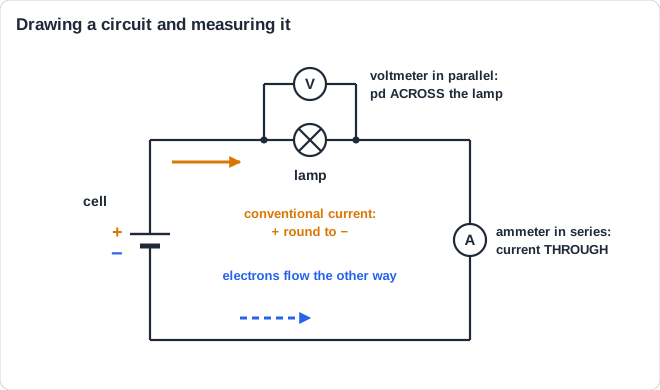
Charge carriers: A current is a flow of charge carriers: free electrons in a metal, positive and negative ions in a salt solution. The direction of a current is always given as conventional current, the way positive charge would flow: from + to −.
Conductor
- Has many charge carriers that are free to move (high mobility).
- Example: copper, where each atom gives up an electron that drifts through the metal.
Insulator
- Its electrons are held tightly in their atoms: almost no mobile charge carriers.
- Example: plastic, rubber or glass round a wire.
Free preview
This is the free notes preview
You're reading the free notes. Aimnova Pro unlocks the full study experience — and you can try it with your first topic free to keep:
- FlashcardsLock in vocabulary and key terms with spaced repetition.
- Practice questionsAnswer exam-style questions and get instant AI marking.
- Mock exams & past-paper vaultSit full mocks and see exactly how examiners award marks.
- Personalised study planA daily plan built around your exam date and weak areas.
Current is the rate of flow of charge — the charge Δq that flows divided by the time Δt it takes:
- electric current (A, amperes)
- charge that flows past a point (C, coulombs)
- time taken for that charge to flow (s)
Δq = charge, I = current, Δt = time. Cover the one you want: two side by side → multiply; one above the other → divide.
Interactive diagram
Explore the labelled diagram, charts and maps for this topic in full study mode.
Potential difference is the energy per unit charge — the energy W given to the charge divided by the amount of charge q:
- potential difference / voltage (V, volts)
- energy given to the charge (J, joules)
- amount of charge moved (C, coulombs)
W = energy, V = voltage, q = charge. Cover the one you want: two side by side → multiply; one above the other → divide.
Interactive diagram
Explore the labelled diagram, charts and maps for this topic in full study mode.
Potential difference, exactly: The pd between two points is the work done per unit charge moving a positive charge from one point to the other: V = W/q.
Through a resistor, positive charge moves from the higher-potential end (nearer the + terminal) to the lower one, and the field does positive work on it. A negative charge, such as −1 C, moves the opposite way; 2.0 J of work across 2.0 V means 1 C of charge, far more than one electron.
The same current all the way along: Charge cannot pile up or vanish in a wire, so in a single path the current is the same at every point, even where the wire is thicker or thinner.
A charge of 12 C flows through a wire in 4.0 s. Find the current in the wire.
Model answer plan
See the answer broken into clear points, with guidance on how each point earns marks.
A belt 0.40 m wide carries charge 2.0 mC m⁻² on its surface and moves at 3.0 m s⁻¹. All the charge is removed at one point into a wire. Calculate the current in the wire.
Model answer plan
See the answer broken into clear points, with guidance on how each point earns marks.
See how examiners mark answers
Answer exam-style questions with model answers. Learn exactly what earns marks and what doesn't.
How this is tested — these definitions sit under every circuit question:
Paper 1A
- A one-mark calculation — most often find a current from a charge delivered over a time (charge ÷ time).
Paper 2
- Longer problems that start by defining current or voltage before the circuit work.
The classic trap: Mixing up the two formulas. Current uses charge ÷ time; voltage uses energy ÷ charge — don't divide by time for voltage.
Read the question for the rate: If a question gives a charge delivered every second (or 'per second'), that rate is the current directly. Otherwise divide the total charge by the total time.
The words to know
| Word | What it means |
|---|---|
| Charge carrier | A charged particle free to move: an electron in a metal, an ion in a solution |
| Conventional current | The direction positive charge would flow: from + to − outside the cell |
| Potential difference | Work done per unit charge moving a positive charge between two points |
| Conductor | A material with many mobile charge carriers |
A moving rubber belt carries charge up to a metal dome. The belt delivers 0.80 C of charge into a wire every 5.0 s. Find the current in the wire.
Model answer plan
See the answer broken into clear points, with guidance on how each point earns marks.