The big idea: A gas is just tiny particles flying around and bouncing off the walls. That one picture explains both pressure and temperature.
Pressure
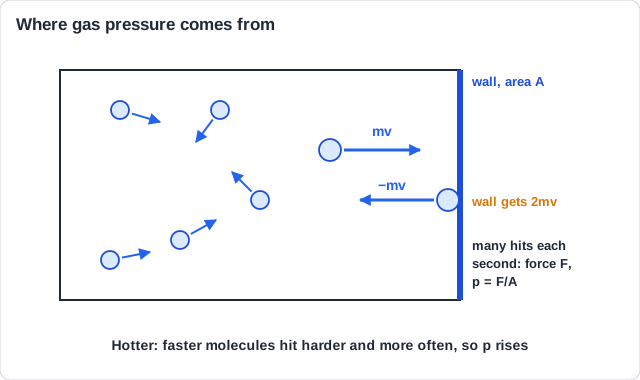
- Caused by those particles hitting the walls
- Each collision gives the wall a tiny push
- Billions of them together make a steady force on every bit of wall
Temperature
- Measures how fast the particles move
- The hotter the gas, the faster they go
What 'absolute temperature' means: Absolute temperature is measured in kelvin (K), starting from absolute zero (0 K = −273 °C), the coldest possible point where particle motion is least.
To go from Celsius to kelvin, add 273: 27 °C = 300 K. Always use kelvin in the kinetic-model formulas.
The key link — energy and temperature: The average kinetic energy of the particles (the energy of their motion) is proportional to the absolute temperature.
In short: average KE ∝ T (with T in kelvin). Double the temperature in kelvin → double the average kinetic energy.
Animated graph
Watch the graph build step by step in study mode.
Spot it: Faster particles → harder, more frequent wall collisions → higher pressure.
Higher temperature → more average kinetic energy → faster particles. Temperature and average kinetic energy go up together.
Where the pressure comes from
- pressure (Pa)
- density of the gas (kg m⁻³)
- mean square speed (m² s⁻²)
Pressure and mean kinetic energy: Since ρ = Nm/V and Ē_k = ½mv̄², the same result reads p = 2/3 (N/V) Ē_k: more molecules per unit volume, or faster ones, mean more pressure.
Air at 1.2 kg m⁻³ and 1.0 × 10⁵ Pa: v̄² = 3p/ρ = 2.5 × 10⁵ m² s⁻², a root-mean-square speed of about 500 m s⁻¹.
The model and real gases: The kinetic model assumes: a very large number of molecules in random motion; molecules much smaller than the gaps between them (their own volume is negligible); no forces between molecules except during collisions; elastic collisions that take negligible time.
A real gas behaves like this ideal gas at low pressure, high temperature and low density: the molecules are far apart and fast, so their size and the forces between them hardly matter. Near liquefaction (high pressure, low temperature) the model fails.
Free preview
This is the free notes preview
You're reading the free notes. Aimnova Pro unlocks the full study experience — and you can try it with your first topic free to keep:
- FlashcardsLock in vocabulary and key terms with spaced repetition.
- Practice questionsAnswer exam-style questions and get instant AI marking.
- Mock exams & past-paper vaultSit full mocks and see exactly how examiners award marks.
- Personalised study planA daily plan built around your exam date and weak areas.
The link between average kinetic energy and absolute temperature is given as a formula. kB is the Boltzmann constant — a fixed number (1.38 × 10⁻²³ J K⁻¹) that connects energy to temperature for a single particle.
- average kinetic energy of one particle (J)
- Boltzmann constant (1.38 × 10⁻²³ J K⁻¹)
- absolute temperature, in kelvin (K)
Two things to get right: 1. Always put T in kelvin — add 273 to a Celsius temperature first.
2. This is the average kinetic energy of one particle. It does not depend on the gas's mass or what gas it is — only on the temperature.
A sample of helium is at 27 °C, with kB = 1.38 × 10⁻²³ J K⁻¹. Find the average kinetic energy of one helium particle.
Model answer plan
See the answer broken into clear points, with guidance on how each point earns marks.
- internal energy (J)
- number of molecules, amount in moles
- temperature (K)
0.30 m³ of helium at 300 K and 1.0 × 10⁵ Pa is in a rigid container and gains 9.0 kJ of thermal energy. Calculate its rise in temperature.
Model answer plan
See the answer broken into clear points, with guidance on how each point earns marks.
Get feedback like a real examiner
Submit your answers and get instant feedback — what you did well, what's missing, and exactly what to write to score full marks.
How this is tested — this micro is tested mostly as explanation, not just calculation:
Paper 1A
- A quick explain / identify question — e.g. why molecular speed rises when a gas is compressed.
- Or why two gases at the same temperature have the same average kinetic energy.
Paper 2
- Link the particle picture to pressure and temperature in words.
The classic trap: Thinking a heavier gas has more kinetic energy at the same temperature. It does not — at the same temperature every gas has the same average kinetic energy (the heavier particles just move more slowly).
Compression and speed: When a piston pushes in quickly, it does work on the gas. That work goes into the particles' motion, so their average kinetic energy rises — which means a higher temperature and faster particles.
Faster particles also hit the walls harder and more often, so the pressure goes up too.
The words to know
| Word | What it means |
|---|---|
| Ideal gas | A gas that follows the kinetic model exactly: point molecules, no forces except in collisions |
| Mean square speed | The average of v² over all the molecules |
| Internal energy of an ideal gas | Total random kinetic energy: U = 3/2 nRT for a monatomic gas |
| Elastic collision | A collision in which no kinetic energy is lost |
A gas is sealed in a cylinder by a piston. The piston is suddenly pushed in, quickly compressing the gas. Explain, using the kinetic model, why the average speed of the gas molecules increases.
Model answer plan
See the answer broken into clear points, with guidance on how each point earns marks.