Addition rule
How to read it
P( )
The probability of what is inside the brackets.
Or
A or B or both: at least one happens.
∪ means "or".
And
A and B: both happen.
∩ means "and".
Why subtract intersection?: If events overlap, we count intersection twice.
Subtract once to correct.
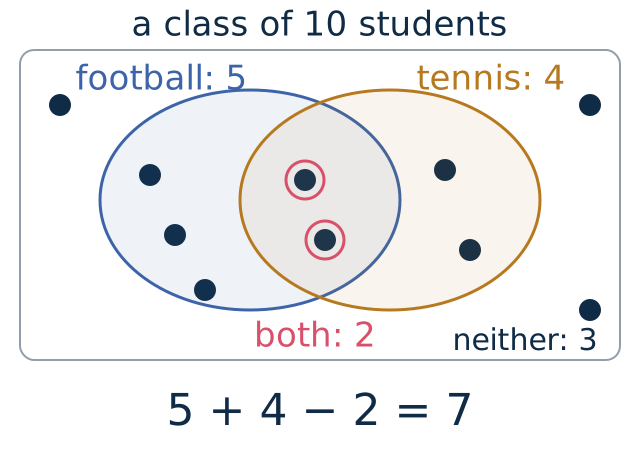
Example: football or tennis
In a class of 10 students, 5 play football, 4 play tennis and 2 play both. A student is chosen at random.
Find the probability that the student plays football or tennis.
Solution
- 5 + 4 − 2 = 7 students play football or tennis.
- Or use the rule with probabilities.
Final answer
7/10 = 0.7
Worked example
P(A)=0.4, P(B)=0.3, P(both)=0.1.
Find P(A or B).
Solution
- P(A or B)=0.4+0.3-0.1
- P(A or B)=0.6
Final answer
0.6 (subtract 0.1 to avoid double-counting).
Free preview
This is the free notes preview
You're reading the free notes. Aimnova Pro unlocks the full study experience — and you can try it with your first topic free to keep:
- FlashcardsLock in vocabulary and key terms with spaced repetition.
- Practice questionsAnswer exam-style questions and get instant AI marking.
- Mock exams & past-paper vaultSit full mocks and see exactly how examiners award marks.
- Personalised study planA daily plan built around your exam date and weak areas.
Multiplication rule and independence
How to read it
For independent events.
P( )
The probability of what is inside the brackets.
And
A and B: both happen.
∩ means "and".
Times
Multiply the two probabilities.
Independent events: Independent (one does not change the other): multiply as they are, e.g. 0.2 × 0.3.
Not independent: still multiply, but the second probability changes, e.g. 3 red and 2 blue, not put back: 3/5 × 2/4.
Worked example
A train is late with probability 0.2. On any day, independently, it rains with probability 0.3.
Find the probability that the train is late and it rains.
Solution
- P(late) = 0.2, P(rain) = 0.3. Independent: one does not change the other.
- P(late and rain) = 0.2 × 0.3 = 0.06
Final answer
0.06. Independent, so multiply.
Memorize terms 3x faster
Smart flashcards show you cards right before you forget them. Perfect for definitions and key concepts.
Conditional probability
How to read it
Given
B, given that A has happened.
| means "given".
Top
A and B both happen.
Bottom
A happens: the group you look at.
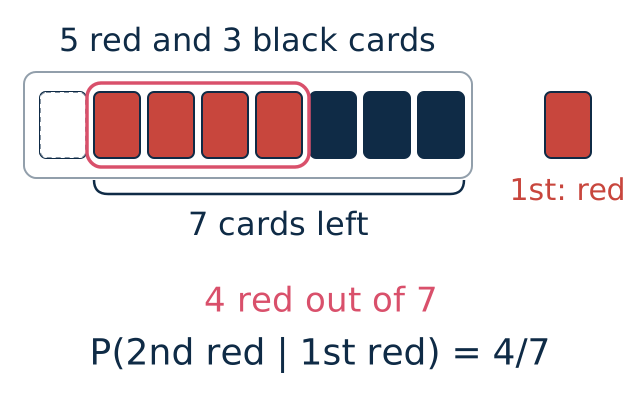
What it means: You already know A happened, so look only at the A group. Then ask: what fraction of that group is B?
E.g. 12 students are in the chess club and 3 of them wear glasses: P(glasses | chess club) = 3/12.
Worked example
A bag has 6 green and 4 yellow sweets. Two sweets are taken, one after the other, without putting the first back.
The first sweet is green. Find the probability that the second sweet is yellow.
Solution
- Given the first sweet is green: 9 sweets are left. All 4 yellow sweets are still there.
- Look only at the sweets that are left.
Final answer
4/9 ≈ 0.444
Show it: mutually exclusive or independent?
Mutually exclusive?: Means: they cannot happen together.
Test: is P(A ∩ B) = 0?
0 → mutually exclusive. More than 0 → not mutually exclusive.
Independent?: Means: one does not change the probability of the other.
Test: work out P(A) × P(B). Is it the same as P(A ∩ B)?
Same → independent. Different → not independent.
Mutually exclusive?
In a class of 28, 9 students play the piano, 12 play football and 4 do both. Are "plays the piano" and "plays football" mutually exclusive? Justify your answer.
Solution
- Mutually exclusive means they cannot happen together, so P(both) would be 0.
- 4 students do both.
Final answer
No: 4 students play both, so P(P ∩ F) = 4/28 ≠ 0. The events are not mutually exclusive.
Independent?
In a class of 20 students, 8 wear glasses, 10 play a sport and 4 do both. A student is chosen at random. Are "wears glasses" and "plays a sport" independent? Justify your answer.
Solution
- Find each probability from the question.
- Multiply them.
- Find P(both) from the question.
- Compare: they are the same.
Final answer
Yes: P(G) × P(S) = 0.2 = P(G ∩ S), so the events are independent.
Exam tip: "Justify" = the number that shows it AND the conclusion. "No" alone scores 0.