Read probabilities from a two-way table
Question: dogs and cats: There are 100 households.
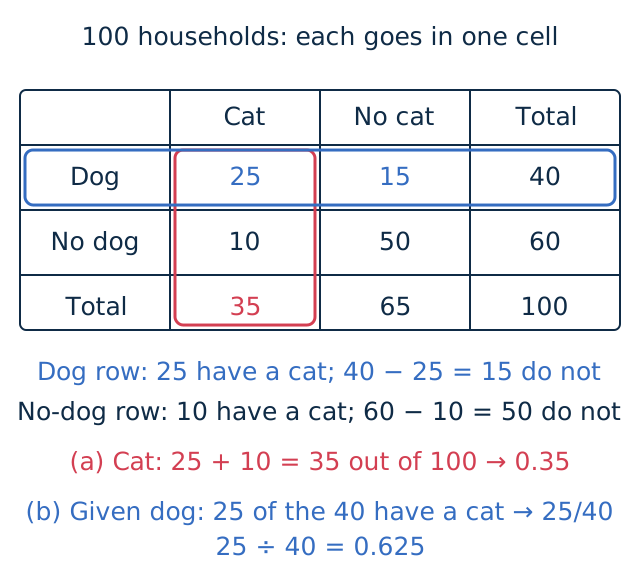
40 own a dog, and 25 of these also own a cat.
Of the 60 households without a dog, 10 own a cat.
One household is chosen at random.
(a) What is the probability that it owns a cat?
(b) Given that it owns a dog, what is the probability that it also owns a cat?
Answer (a): owns a cat
(a) Find the probability that the household owns a cat.
Step by step
- 25 dog owners and 10 households without a dog own a cat: 35 altogether.
Final answer
0.35, or 35%.
Answer (b): cat, given dog
(b) Given that the household owns a dog, find the probability that it owns a cat.
Step by step
- Use only the 40 dog owners. Of these, 25 also own a cat.
Final answer
0.625, or 62.5%.
Free preview
This is the free notes preview
You're reading the free notes. Aimnova Pro unlocks the full study experience — and you can try it with your first topic free to keep:
- FlashcardsLock in vocabulary and key terms with spaced repetition.
- Practice questionsAnswer exam-style questions and get instant AI marking.
- Mock exams & past-paper vaultSit full mocks and see exactly how examiners award marks.
- Personalised study planA daily plan built around your exam date and weak areas.
"At least one": use the complement
Three independent free throws
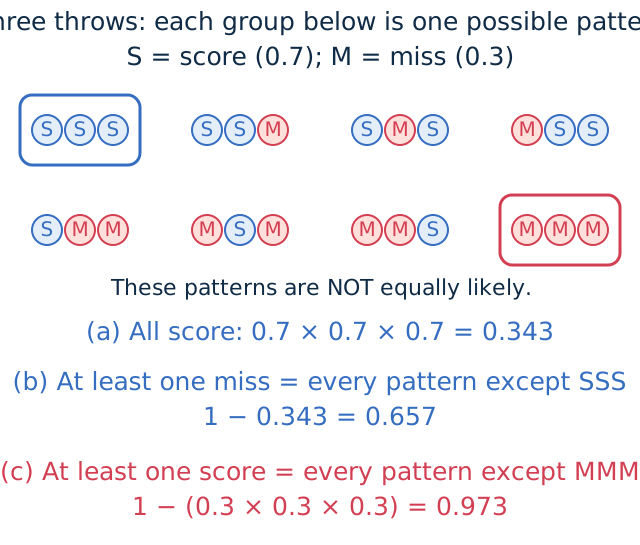
Ana scores each free throw with probability 0.7, independently of the others. She takes three free throws.
(a) Find the probability that she scores all three.
Solution
- Independent: multiply.
Final answer
0.343.
Part (b)
(b) Find the probability that she misses at least one.
Solution
- "Misses at least one" is everything except "scores all three".
Final answer
0.657.
Part (c)
(c) Find the probability that she scores at least one.
Solution
- "None" means three misses, each with probability 1 − 0.7 = 0.3.
Final answer
0.973.
Why not add the cases?
"At least one score" in three throws is 7 different patterns. "None" is one pattern: one subtraction replaces seven products.
"At most one" — same trick?
Yes, when the opposite is short.
Example: two throws, at most one score = 1 − P(both score) = 1 − 0.49 = 0.51.
Exam tip: Write "1 − P(none)" before the numbers: it is the method mark.
Practice with exam-style questions
Answer exam-style questions and get AI feedback that shows you exactly what examiners want to see in a full-marks response.
"Exactly … in total": list the cases
List every way, then add: A total over two independent games can be made in several ways. Write each way as a product, then add the products.
| Points in one game | 0 | 1 | 2 |
|---|---|---|---|
| Probability | 0.3 | 0.5 | 0.2 |
A total of 2 points in two games
In one round of a game, Leo wins 0, 1 or 2 points with the probabilities in the table. He plays two rounds, independently. Find the probability that he wins exactly 2 points in total.
Solution
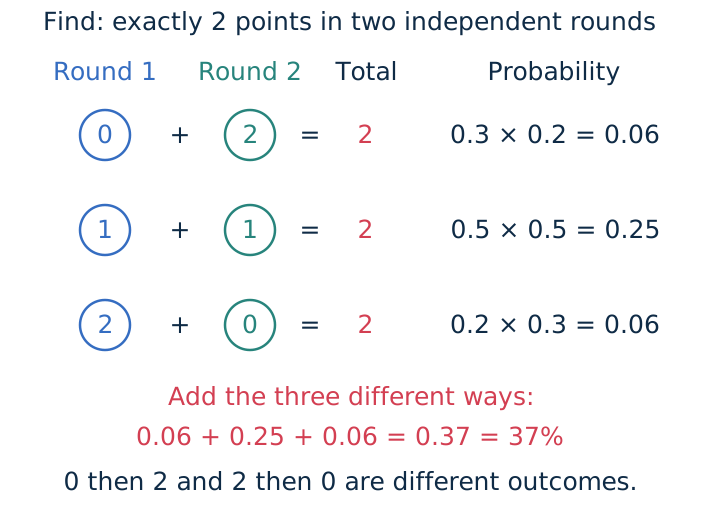
- The ways to make 2: (0 then 2), (1 then 1), (2 then 0).
- Multiply along each way.
- Add the ways.
Final answer
0.37
Why is (0, 2) different from (2, 0)?
They are different results in different rounds. Each one is counted.
Check: (1, 1) happens in only one way, so it is counted once.
How many marks for the cases?
Usually one method mark per correct product, and one for adding them. Show each product.
Exam tip: Missing the reversed order — (2, 0) as well as (0, 2) — is the most common lost mark.
Two different experiments: list the sample space
A grid shows every equally likely pair: One experiment down the side, the other across the top. Every cell is one equally likely outcome.
Coin then die
In a game, a fair coin is tossed and then a fair six-sided die is rolled. Tails: the score is the number on the die. Heads: the score is the number on the die plus 1.
(a) Find the probability that the score is 7.
Solution
- There are 2 × 6 = 12 equally likely pairs (the grid).
- A score of 7 needs heads AND a 6: one cell. Or multiply.
Final answer
1/12 ≈ 0.0833.
Part (b)
(b) Find the probability that the score is 4.
Solution
- A score of 4: tails and 4, or heads and 3 — 2 cells.
Final answer
1/6 ≈ 0.167.
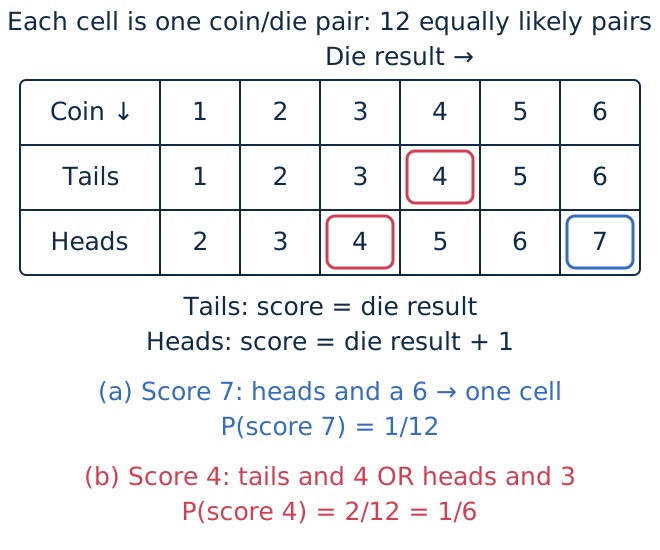
Exam tip: Say which pairs give the score: "only heads and a 6 gives 7" is the method mark before the product.
Feeling unprepared for exams?
Get a clear study plan, practice with real questions, and know exactly where you stand before exam day. No more guessing.
Without replacement: several picks from a group
A chosen person stays out: After every pick, the total drops by 1. The number in a group drops only if someone from that group was chosen.
For example: choose a chess player → 12 chess out of 30 becomes 11 chess out of 29.
Choosing a team
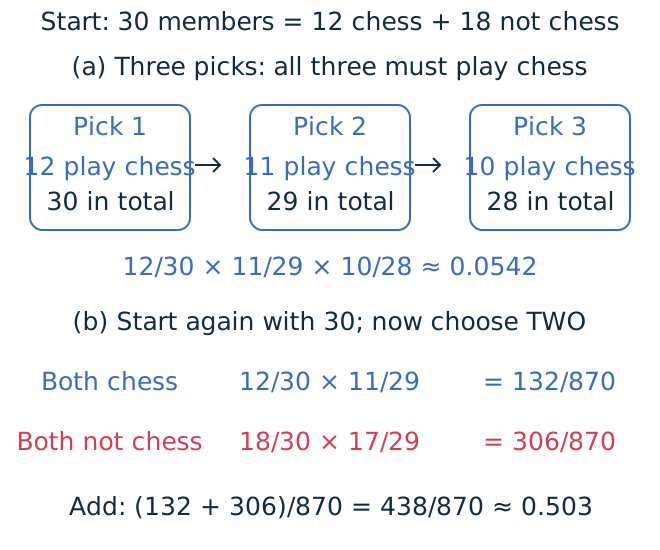
A club has 30 members. 12 of them play chess. Members are chosen at random, one after another.
(a) Three members are chosen. Find the probability that all three play chess.
Solution
- Multiply three fractions; top and bottom each drop by 1.
Final answer
0.0542.
Part (b)
(b) Start again with all 30 members. Two members are chosen at random, without replacement. Find the probability that both play chess or both do not play chess.
Solution
- Two ways to match: both chess, or both not (18 members do not play).
- Add the two products.
Final answer
0.503.
From a two-way table?
Take the group size and the grand total from the table, then use the same products.
Example: 25 of 80 applicants chose Art → both chose Art = (25/80) × (24/79).
With replacement instead?
The numbers stay the same each time.
Example: (12/30) × (12/30).
Exam tip: Write the full product of fractions before the decimal: one mark is for the product, one for the correct fractions.