Sample space and events
Probability: How likely something is: a number from 0 (impossible) to 1 (certain).
What is a sample space?: The sample space, written U, is the set of all possible outcomes of a trial.
For one coin toss: U = {heads, tails}. For one die roll: U = {1, 2, 3, 4, 5, 6}.
An event is a selection of those outcomes. For example, “roll an even number” means {2, 4, 6}.
Interactive diagram
Explore the labelled diagram, charts and maps for this topic in full study mode.
Trial and outcome: Picking one student is a trial. "Walks" is one possible outcome.
Check two things before you divide: 1. U holds every possible outcome: all 25 students, none left out.
2. Every outcome is equally likely: each student has the same chance of being picked.
Free preview
This is the free notes preview
You're reading the free notes. Aimnova Pro unlocks the full study experience — and you can try it with your first topic free to keep:
- FlashcardsLock in vocabulary and key terms with spaced repetition.
- Practice questionsAnswer exam-style questions and get instant AI marking.
- Mock exams & past-paper vaultSit full mocks and see exactly how examiners award marks.
- Personalised study planA daily plan built around your exam date and weak areas.
Calculating probabilities
Interactive diagram
Explore the labelled diagram, charts and maps for this topic in full study mode.
Exam-style question [2 marks]
A month of the year is chosen at random.
(a) Find the probability that its name starts with M.
Solution
- List U: the 12 months, each equally likely.
- A = {March, May}.
- Divide.
Final answer
1/6 ≈ 0.167
Part (b)
(b) Find the probability that its name does not start with M.
Solution
- Not A: subtract from 1.
Final answer
5/6 ≈ 0.833
Exam tip: Give the answer as a fraction (2/12 or 1/6), a decimal (0.167, to 3 significant figures) or a percentage (16.7%): all get full marks.
Never wonder what to study next
Get a personalized daily plan based on your exam date, progress, and weak areas. We'll tell you exactly what to review each day.
Complementary events
Complementary: Events covering all: P(A) + P(A′) = 1.
Example: a flight is late, or it is not late.
Worked example
P(rain)=0.3.
Find P(no rain).
Solution
- Rain and no rain cover every day, and cannot both happen.
- P(no rain) = 1 − 0.3 = 0.7
Final answer
0.7
"Not A" in words: Exam questions often ask which wording means A′. A′ is everything that is not in A.
Interactive diagram
Explore the labelled diagram, charts and maps for this topic in full study mode.
Two dice: the 36-outcome grid
What is a sample space diagram?: A sample space diagram organises every possible outcome in a list or grid, with none missed or repeated.
For two experiments, put the outcomes of one down the rows and the outcomes of the other across the columns. Each cell records one possible pair.
If the outcomes are equally likely, find a probability by counting the matching cells and dividing by the total number of cells.
Start with a smaller grid: toss a fair coin and independently spin a fair spinner numbered 1, 2, 3. Put the coin result down the side and the spinner result across the top.
| Coin / spinner | 1 | 2 | 3 |
|---|---|---|---|
| Heads | (H, 1) | (H, 2) | (H, 3) |
| Tails | (T, 1) | (T, 2) | (T, 3) |
Read one cell, then count: (H, 2) means heads AND spinner 2. There are 2 × 3 = 6 equally likely pairs.
“Heads and an even number” matches only (H, 2), so its probability is 1/6. “Heads” matches the three cells in the Heads row, so its probability is 3/6 = 1/2.
Now use the same idea for two dice
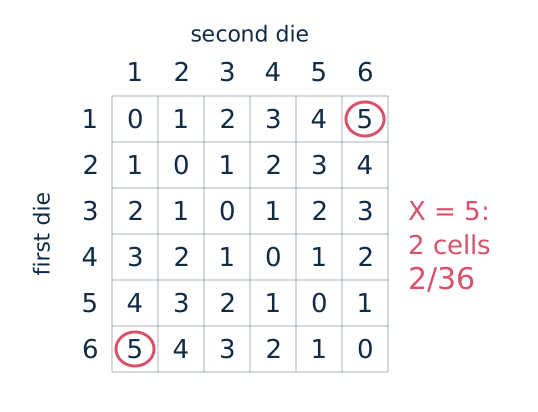
For two independent fair six-sided dice, use 6 rows for the first die and 6 columns for the second die. There are 6 × 6 = 36 equally likely ordered pairs.
The cell at row 2, column 5 represents (2, 5). The cell at row 5, column 2 represents (5, 2). They are different outcomes, even though both sums are 7.
The grid below writes the sum inside each cell. Count the cells matching the event; do not count only the different sums.
Interactive diagram
Explore the labelled diagram, charts and maps for this topic in full study mode.
Stop wasting time on topics you know
Our AI identifies your weak areas and focuses your study time where it matters. No more overstudying easy topics.
Two dice: counting pairs in the exam
No grid? Go through the first die: For one event, try each value of the first die and ask what the second die must be. It must be 1 to 6. This way no pair is missed, including the reversed one.
| First die | Second die needed (11 − first) | Possible? |
|---|---|---|
| 1 | 10 | no |
| 2 | 9 | no |
| 3 | 8 | no |
| 4 | 7 | no |
| 5 | 6 | yes: (5, 6) |
| 6 | 5 | yes: (6, 5) |
Another check: product = 12: Same method, different rule: the second die must be 12 ÷ first die, and it must be a whole number from 1 to 6.
| First die | Second die needed (12 ÷ first) | Possible? |
|---|---|---|
| 1 | 12 | no |
| 2 | 6 | yes: (2, 6) |
| 3 | 4 | yes: (3, 4) |
| 4 | 3 | yes: (4, 3) |
| 5 | 2.4 | no (not a whole number) |
| 6 | 2 | yes: (6, 2) |
P(product = 12): 4 pairs work: (2, 6), (3, 4), (4, 3), (6, 2). So P(product = 12) = 4/36 = 1/9.
One event, or several?: Only (5, 6) and (6, 5) work, so P(sum = 11) = 2/36.
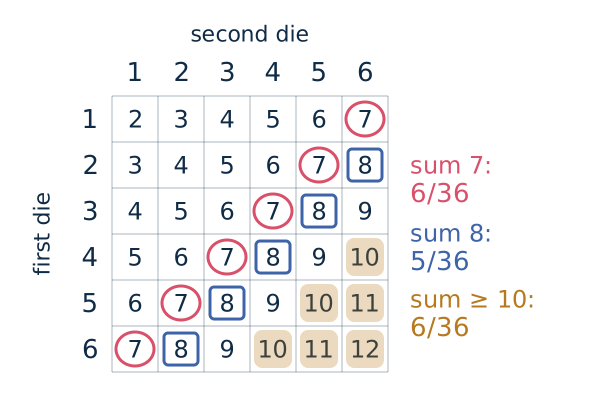
One event: go through the first die like this. Several events in one question (e.g. P(sum = 7), P(sum = 8) and P(sum ≥ 10)): draw the 6 × 6 grid once and count each from it.
Exam-style question [2 marks]
Two fair six-sided dice are rolled.
(a) Find the probability that the sum is at least 10.
Solution
- U: 36 equally likely pairs.
- Count in the sum grid: 10, 11 or 12 sits in 6 cells, (4, 6), (5, 5), (6, 4), (5, 6), (6, 5), (6, 6).
Final answer
1/6 ≈ 0.167
Part (b)
(b) Find the probability that the product of the two numbers is 6.
Solution
- Go through the first die: the second must be 6 ÷ first, a whole number from 1 to 6. 1 → 6 yes, 2 → 3 yes, 3 → 2 yes, 4 → 1.5 no, 5 → 1.2 no, 6 → 1 yes. So (1, 6), (2, 3), (3, 2), (6, 1): 4 pairs.
Final answer
1/9 ≈ 0.111
Exam tip: Count the pairs, not the totals. A sum of 7 can be made 6 ways: (1, 6), (2, 5), (3, 4), (4, 3), (5, 2), (6, 1). A sum of 12 can be made only 1 way: (6, 6). So P(sum = 7) = 6/36 and P(sum = 12) = 1/36.
Additional AA exam practice
IB-style question — single event
A bag holds 5 red, 3 blue and 2 green counters.
One is taken at random.
Find the probability it is red.
Step by step
- Total counters.
- Favourable ÷ total.
Final answer
P(red) = 1/2.
IB-style question — at least one
Two fair dice are rolled.
Find the probability of getting at least one six.
Step by step
- P(no six on one die) = 5/6, so P(no six on both).
- Complement.
Final answer
P(at least one six) = 11/36.
IB-style question — two dice
Two fair dice are rolled and the scores added.
Find the probability the total is 7.
Step by step
- Total outcomes in the grid.
- Outcomes giving 7: (1,6),(2,5),(3,4),(4,3),(5,2),(6,1).
Final answer
P(total = 7) = 1/6.
IB-style question — without replacement
A box has 4 red and 6 blue pens.
Two are drawn without replacement.
Find the probability both are red.
Step by step
- First red: 4 of 10.
- Second red: now 3 of 9. Multiply.
Final answer
P(both red) = 2/15.
IB-style question — single event
A spinner has 12 equal sectors: 4 are yellow, 5 are red and 3 are green.
The spinner is spun once.
Find the probability it lands on yellow.
Step by step
- Total equally likely sectors.
- Favourable ÷ total.
Final answer
P(yellow) = 1/3.