What 'peace & conflict' covers: Peace & conflict is part of the theme Sharing the Planet. You need vocabulary to talk about conflict and how people resolve it peacefully.
What you need words for
- disagreements
- dialogue
- living together
- resolving conflicts peacefully
- giving your opinion about them
Use the list as a glossary: The words below are common English B vocabulary. Treat the list as a glossary: learn each term with its meaning and a synonym, then reuse them in the reading and writing sections.
- peace
- a state of calm, with no fighting or war
- conflict
- a serious disagreement or argument, often a long one
- dialogue
- a conversation in which people exchange ideas to understand each other
- coexistence / to live together
- people of different views or backgrounds living side by side peacefully
- respect
- treating other people and their views as worthy of consideration
- tolerance
- accepting beliefs or behaviour you may not share
- to argue
- to disagree, often in a heated or repeated way
- to fight
- to take part in a physical or verbal struggle
- to resolve / solve a problem
- to find an answer that ends a difficulty
- to reach an agreement
- to come to a shared decision both sides accept
- mediation
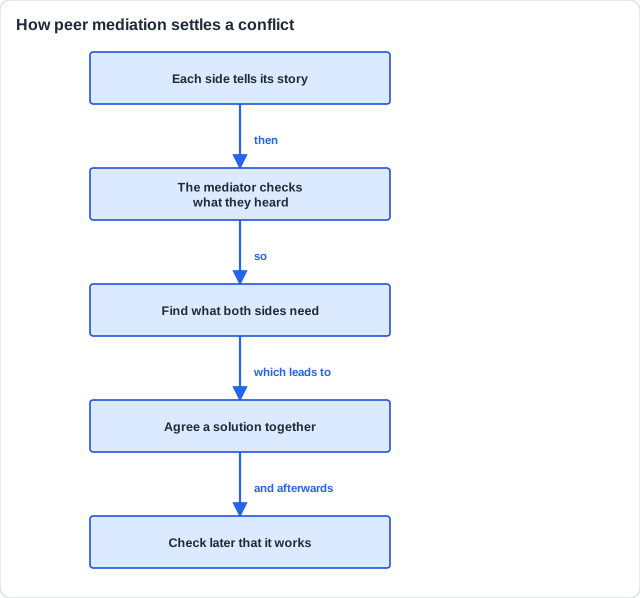
- the act of helping two sides settle a dispute by talking, with a neutral third person
- war
- armed fighting between countries or groups
- a refugee
- a person who has fled their country to escape war or danger
| Useful expression | What it means |
|---|---|
| It's better to talk things through than to fight. | Dialogue is more useful than confrontation. |
| I try to reach an agreement with everyone. | I aim for a shared decision, not a winner. |
| You have to respect people who think differently. | Accept other views even if you don't share them. |
| Peace starts with small gestures. | Big change begins with everyday acts of kindness. |
| We learned to solve our conflicts by talking. | Conversation, not force, ended our disputes. |
Why this matters: This vocabulary turns up in every skill — a reading text on living together, a listening interview about a school mediation scheme, a Paper 1 blog, or your oral. Reusing precise topic words is how you score Criterion A (Language).
Free preview
Reading it is one thing — hearing it is another
You're reading the free notes. Aimnova Pro unlocks the full study experience — and you can try it with your first topic free to keep:
- Audio on every wordTap any vocabulary word or example to hear it read aloud in natural English.
- FlashcardsLock in vocabulary and key terms with spaced repetition.
- Practice questionsAnswer exam-style questions and get instant AI marking.
- Mock exams & past-paper vaultSit full mocks and see exactly how examiners award marks.
- Personalised study planA daily plan built around your exam date and weak areas.
Have something to say: Examiners reward developed ideas, not just vocabulary. Around peace & conflict, the common debates are: dialogue vs confrontation, how to live together when people disagree, and what role respect and tolerance play. Take a position and back it up.
Opinion phrases (use these to introduce a view)
- In my opinion… / From my point of view… — to introduce what you think
- It seems to me that… / I believe that… — a slightly softer way to give a view
- The most important thing is… — to highlight your main point
- On the one hand… on the other hand… — to weigh up two sides
- I (completely) agree that… / I'm not convinced that… — to react to an idea
Conflict without dialogue
- When nobody listens, problems only grow.
- Fighting breaks down trust and creates more tension.
- A lack of respect makes any agreement impossible.
Dialogue and peace
- By talking, both sides understand each other's position.
- Mediation helps people find a fair solution.
- Respect lets us live together even when we think differently.
Everyday conflict
- Arguments over shared spaces at school
- Peer mediation and talking it through
- A buddy bench for lonely children
After a war
- Former fighters learning a new life
- Old enemies working side by side
- Moments of peace in the middle of war
Making places safe
- Clearing landmines from fields
- Peace camps for young people from both sides
- Refugees and the right to a safe home
- mediation / a mediator
- help from a neutral person to end a disagreement / that person
- to resolve (a conflict)
- to find a solution to it
- a truce / a ceasefire
- an agreement to stop fighting for a time
- reconciliation
- becoming friendly again after a serious conflict
- a peace agreement
- a formal deal that ends a war
- to flee (fled, fled)
- to escape from danger, often leaving your home
Link your ideas: Connectors lift your answer from a list into an argument: moreover (to add), however (to contrast), therefore (to conclude), although (to concede). Use at least two or three in any written answer.
Stop wasting time on topics you know
Our AI identifies your weak areas and focuses your study time where it matters. No more overstudying easy topics.
Read like Paper 2: Here is a short blog post — the kind of text Paper 2 (Reading) gives you. Read it once just for the general idea; don't worry about every word. Then we'll work through one exam question together.
Learning to live together (1 of 3): Last year, at my school, two groups of students argued every day over the use of the playground. The atmosphere was very tense and almost nobody spoke to one another.
Learning to live together (2 of 3)
So some teachers set up a peer-mediation group. Instead of punishing us, they taught us to listen to the other person and to look for a solution together. At first I felt embarrassed, but soon I understood that talking things through is better than fighting.
Learning to live together (3 of 3)
Now we share the playground in turns and we solve problems by talking. We don't always agree, but we have learned to live together in peace and to respect one another.
- tense
- full of stress or anxiety; on edge
- peer mediation
- students helping other students settle a dispute by talking
- to feel embarrassed
- to feel awkward or self-conscious
- to talk things through
- to discuss a problem fully until it is resolved
- to live together in peace
- to coexist calmly, without fighting
IB-style task — one Paper 2 question
One question, step by step
- The question — "According to the text, what did the teachers do to improve the atmosphere?"
- Find it in the text. Look for the word "teachers": "So some teachers set up a peer-mediation group."
- The answer — They set up a peer-mediation group. The words are right there in the text, so no outside knowledge is needed.
Reading technique: For an "according to the text" question, find the exact line that proves your answer — don't rely on memory or general knowledge.
The task: Your school is running a campaign on living together peacefully. Write a leaflet for other students: explain how conflicts start and give advice for resolving problems in peace.
Write 450–600 words.
Leaflet structure — 4 steps
Title
A clear title that says what the leaflet is for. "Fighting? There's another way to sort it out."
Sections with subheadings
Short sections, each under a bold subheading. "Why conflicts grow."
Bullet points
List the key advice as short bullets. "• Listen before you reply. • Talk things through."
Practical information and call to action
Where, when, who to contact, and what to do now. "Need help? Room 8, every lunchtime"
Title → Subheadings → Bullet points → Information + call to action
Model: the 4 steps in ~100 words
The leaflet, step by step
- Fighting? There's another way to sort it out.
- Why conflicts grow. Most arguments in class start small: a joke, a rumour, a message taken the wrong way. When nobody listens, they get worse. Last year our class argued about everything — until we tried talking instead.
- Three steps to peace • Listen to the other person before you reply. • Talk things through instead of fighting. • Look for a solution that is fair for everyone.
- Need help? Our trained student mediators are in Room 8 every lunchtime. Come and talk — it's free and confidential.
Why it works: A strong leaflet does this for each of the three Paper 1 criteria:
A — Language /12
- Range of tenses: present "arguments start", past "our class argued", imperatives
- Connectors: "when", "until", "instead of"
- Topic vocabulary: conflict, rumour, mediators
B — Message /12
- Task fully done: explains how conflicts start AND how to resolve them
- Each step is practical
C — Conceptual /6
- Leaflet conventions: a title and bold subheadings
- Bullet points for the steps
- Where to get help, and a call to action
Ready to ace Peace & conflict?
You've seen the preview. Here's what you'll unlock:
Bite-Sized Study Notes
Full syllabus broken into chunks that stick
Exam Practice
See exactly how to score full marks
AI Feedback
Know exactly what examiners want
Smart Study Plan
Know exactly what to study next