What 'education' covers: Education is part of the theme Social organization. You need vocabulary to talk about studying, school and university life, exams and learning habits.
How to use this list
- Give your opinion about them.
- These are common English B words. Treat the list as a glossary.
- Learn each term with its meaning and a synonym.
- Reuse the terms in the reading and writing sections.
- education
- the process of teaching and learning, especially at school or university
- subject
- an area you study, such as maths, history or biology
- to revise
- to study again what you have already learned, especially before a test
- to take notes
- to write down the key points while you read or listen
- to pass / to fail an exam
- to succeed in / to not succeed in an exam
- to get good marks (grades)
- to score well in your work and tests
- timetable
- a plan that shows when you do each lesson or task
- to enrol (in)
- to officially join a course, school or university
- degree
- a qualification you earn by completing a course at university
- scholarship
- money given to a student to help pay for their studies
- to learn by heart
- to memorise something exactly, word for word
- to concentrate
- to give all your attention to one thing
- deadline
- the date or time by which a task must be finished
| Useful expression | What it means |
|---|---|
| I'm good at languages. | Languages are one of my stronger subjects. |
| I have to revise for the exam. | I need to study again before the test. |
| I want to do a science degree. | I plan to take a science course at university. |
| I get better marks when I take notes. | Writing things down improves my results. |
| I find it hard to concentrate at home. | There are too many distractions where I live. |
Why this matters: This vocabulary turns up in every skill — a reading text about school life, a listening interview about study habits, a Paper 1 blog, or your oral. Reusing precise topic words is how you score Criterion A (Language).
Free preview
Reading it is one thing — hearing it is another
You're reading the free notes. Aimnova Pro unlocks the full study experience — and you can try it with your first topic free to keep:
- Audio on every wordTap any vocabulary word or example to hear it read aloud in natural English.
- FlashcardsLock in vocabulary and key terms with spaced repetition.
- Practice questionsAnswer exam-style questions and get instant AI marking.
- Mock exams & past-paper vaultSit full mocks and see exactly how examiners award marks.
- Personalised study planA daily plan built around your exam date and weak areas.
Have something to say: Examiners reward developed ideas, not just vocabulary. Around education, the common debates are: which university degree to choose, the pressure of exams, and using technology like tablets and laptops in class. Take a position and back it up.
Opinion phrases (use these to introduce a view)
- In my opinion… / From my point of view… — to introduce what you think
- It seems to me that… / I believe that… — a slightly softer way to give a view
- The most important thing is… — to highlight your main point
- On the one hand… on the other hand… — to weigh up two sides
- I (completely) agree that… / I'm not convinced that… — to react to an idea
Drawbacks of tablets in class
- They are very distracting — it's easy to open another app.
- Some students just copy answers from the internet.
- Not every family can afford one.
Benefits
- They give access to lots of resources and videos.
- They weigh far less than a pile of textbooks.
- They make lessons more interactive.
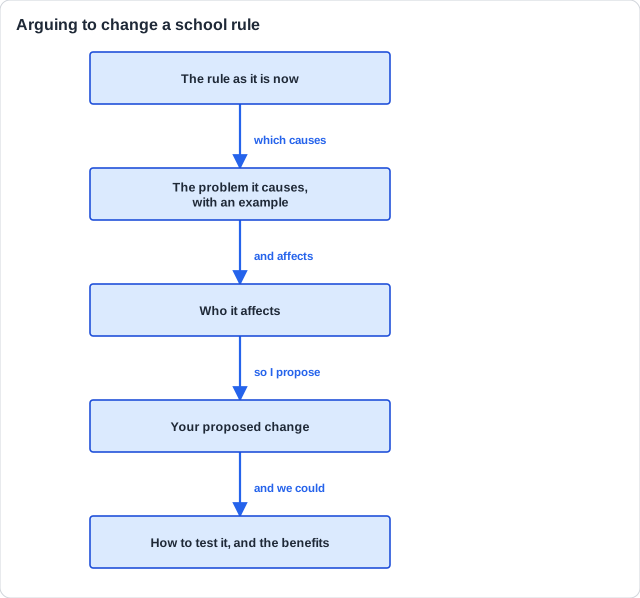
School rules and change
- New rules on phones and devices
- An outdated rule: why and how to change it
- Designing a new subject, homework policies
Ways of learning
- Online learning, and who can access it
- Flipped classrooms and project-based schools
- Learning at home, learning at any age
Next steps
- University or straight to work?
- Tips for a first term at university
- An exchange abroad, an online course
- a school policy
- an official rule or plan a school follows
- the curriculum
- all the subjects and topics a school teaches
- an optional subject
- a subject students can choose, not one everyone must take
- a flipped classroom
- students learn new material at home and practise it in class
- lifelong learning
- continuing to learn throughout your life, not only at school
- freshers
- students in their first weeks at university
Link your ideas: Connectors lift your answer from a list into an argument: moreover (to add), however (to contrast), therefore (to conclude), although (to concede). Use at least two or three in any written answer.
See how examiners mark answers
Answer exam-style questions with model answers. Learn exactly what earns marks and what doesn't.
Read like Paper 2: Here is a short blog post — the kind of text Paper 2 (Reading) gives you. Read it once just for the general idea; don't worry about every word. Then we'll work through one exam question together.
A study room for the final year (part 1): Last month, a few of us in the final year asked the school for a quiet study room. Before that, we had nowhere calm to revise between one lesson and the next.
A study room for the final year (part 2)
The idea worked really well. We started studying in small groups at break time, and we passed more tests because we helped one another. I realised that at home I wasted a lot of time on my phone, but in the room I could concentrate much better.
A study room for the final year (part 3)
The room is now full every day, and the head teacher wants to open a second one. It hasn't been a magic solution, but we have learned to organise our time and to study more effectively.
- to revise
- to study again before a test
- break time
- the short pause between or during lessons
- to concentrate
- to give all your attention to one thing
- to organise your time
- to plan when you do each task
- effectively
- in a way that produces good results
IB-style task — one Paper 2 question
One question, step by step
- The question — "According to the text, why did the students pass more tests?"
- Find it in the text. Look for the words "passed more tests": "we passed more tests because we helped one another."
- The answer — Because they studied in small groups and helped one another. The words are right there in the text, so no outside knowledge is needed.
Reading technique: For an "according to the text" question, find the exact line that proves your answer — don't rely on memory or general knowledge.
The task: Your school is running a study-skills week. Write a formal letter to your head teacher: describe how students study and propose a study-skills session.
Write 450–600 words.
Formal letter structure — 4 steps
Address and date
Your name, address and the date. "Leo Martin, 14 Park Road, Leeds — 3 October 2026"
Formal greeting
Dear Mr or Ms + surname. "Dear Mr Harris,"
Body
Purpose in the first sentence, then the details and your request. "I am writing on behalf of Year 11 to propose…"
Formal close
Yours sincerely + your full name. "Yours sincerely, Leo Martin"
Date → Greeting → Body → Formal close
Model: the 4 steps in ~100 words
The formal letter, step by step
- Leo Martin, 14 Park Road, Leeds — 3 October 2026
- Dear Mr Harris,
- I am writing on behalf of Year 11 to propose a weekly study-skills session. Many students, including me until last year, leave everything until the last day and revise with their phones next to them. When I started to make a realistic timetable and take notes by hand, my grades improved quickly. A one-hour session on these methods each Friday would help everyone, and I am convinced it would really pay off. I would be grateful if you could consider this proposal.
- Yours sincerely, Leo Martin
Why it works: A strong formal letter does this for each of the three Paper 1 criteria:
A — Language /12
- Range of forms: present "students leave", past "my grades improved", conditional "would help"
- Connectors: "including", "when", "and"
- Topic vocabulary: revise, timetable, take notes
B — Message /12
- Task fully done: describes how students study AND proposes a session
- The proposal is backed by his own results
C — Conceptual /6
- Letter conventions: address and date, "Dear Mr Harris", "Yours sincerely"
- Purpose in the first sentence
- Formal register: "I would be grateful if…"
Study smarter, not longer
Most students waste 40% of study time on topics they already know. Our AI tracks your progress and optimizes every minute.
How listening is tested: Paper 2 also tests listening: you hear short clips, each played twice, and you never see the words.
How to answer — 3 steps
Read the questions first
Do this before the clip plays.
Listen for the key idea
Focus on the part each question points to.
Then answer
Use what the speaker actually says.
Questions → Key idea → Answer
Practise on the page: Here we'll use a transcript so you can practise the technique on the page. Read the questions, then find the answer in the speaker's words.
Transcript — how Daniel studies (part 1): Hi, I'm Daniel and I'm in my final year. To get good marks, I make a timetable every Sunday and I revise a little every day. I take notes by hand because that way I concentrate better.
Transcript — how Daniel studies (part 2)
When I'm bad at a subject, I study in a group with my friends. For me, the most important thing is not to leave everything until the last day.
IB-style task — two listening questions
Two questions, step by step
- Q1 — Why does Daniel take notes by hand? Listen just after "I take notes by hand": "because that way I concentrate better." That is your answer.
- Q2 — What does he do when he is bad at a subject? He says it directly: "I study in a group with my friends." Answer: he studies in a group.
Listening technique: Read the questions before the clip plays. Each question usually points to one short part of the recording — listen for the words around it, not the whole thing.