aımnova
DashboardMy LearningCrash CoursesStudy Plan

Aimnova site navigation

Stay in the loop

Get the latest study resources and updates

New features, study tips and exam insights — straight to your inbox.

IB Diploma

  • IB Past Papers
  • IB Study Notes
  • IB Question Bank
  • IB Mock Exams
  • IB Revision

IB Subjects

  • IB Math AA
  • IB Math AI
  • IB Economics
  • IB Business Management
  • IB Physics
  • IB Biology
  • View all IB subjects→

IB Past Papers

  • IB Math AA HL Past Papers
  • IB Math AA SL Past Papers
  • IB Math AI HL Past Papers
  • IB Math AI SL Past Papers
  • IB Economics HL Past Papers
  • IB Economics SL Past Papers
  • IB ESS Past Papers
  • View all past papers→

Study Resources

  • Study Notes
  • Question Bank
  • Mock Exams
  • Crash Courses
  • Flashcards
  • Revision Guide
  • Exam Skills
  • Command Terms
  • Grade Calculator
  • Exam Timetable 2026

Aimnova

  • Features
  • Pricing
  • For Teachers
  • For Schools
  • For Parents
  • About Us
  • Blog
  • Contact
aımnova

IB study, practice and feedback built around the real exam.

TermsPrivacyCookies·© 2026 Aimnova. All rights reserved.d92d737

Aimnova is not affiliated with or endorsed by the International Baccalaureate Organization (IB).

NotesEconomics HLTopic 4.9Poverty cycles
Back to Economics HL Topics
4.9.14 min read

Poverty cycles (Economics HL)

IB Economics · Unit 4

AI-powered feedback

Stop guessing — know where you lost marks

Get instant, examiner-style feedback on every answer. See exactly how to improve and what the markscheme expects.

Try It Free

Contents

  1. 1The poverty cycle
  2. 2Breaking the cycle
  3. 3Exam-style question

A poverty cycle (or poverty trap) is when low income keeps savings and investment low, so productivity and income stay low. Poverty passes from parents to children.
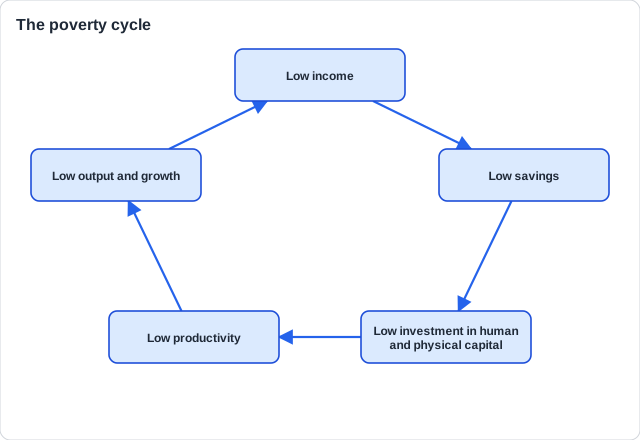
A poverty cycle: low income, then low savings, then low investment in human and physical capital, then low productivity, then low output and growth, back to low income.
Low income leads round the loop back to low income.

The points to remember

  • Start and end the cycle with low income.
  • Always include low investment in human or physical capital: a cycle without it scores nothing.

Free preview

This is the free notes preview

You're reading the free notes. Aimnova Pro unlocks the full study experience — and you can try it with your first topic free to keep:

  • FlashcardsLock in vocabulary and key terms with spaced repetition.
  • Practice questionsAnswer exam-style questions and get instant AI marking.
  • Mock exams & past-paper vaultSit full mocks and see exactly how examiners award marks.
  • Personalised study planA daily plan built around your exam date and weak areas.
Start Studying Free Full access to Aimnova Pro · cancel anytime

A policy breaks the cycle by raising one link in the chain. Show where it enters with an arrow.
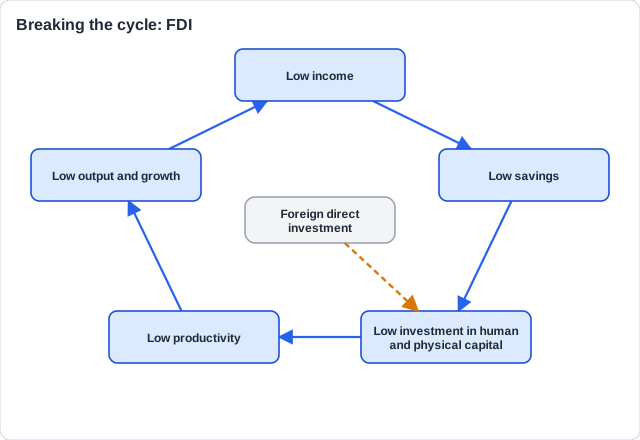
A poverty cycle: low income, then low savings, then low investment in human and physical capital, then low productivity, then low output and growth, back to low income; foreign direct investment raises low investment in human and physical capital.
FDI raises investment in physical capital.

Where policies break the cycle

PolicyWhere it entersWhy the cycle breaks
Free schooling, girls' educationInvestment in human capitalSkills raise productivity
Clinics, clean waterInvestment in human capitalHealthier workers produce more
Foreign direct investment (FDI)Investment in physical capitalFactories, jobs, technology
Aid for roads and powerInvestment in physical capitalLower costs, new markets
Cash transfers, remittancesIncomeFamilies can save and keep children in school
MicrocreditSavings and investmentSmall loans start small firms

See how examiners mark answers

Answer exam-style questions with model answers. Learn exactly what earns marks and what doesn't.

Try Exam Vault FreeYour first topic is free to keep • No credit card required

Paper 3 asked this in November 2024, for 4 marks; Paper 2 asks the same shape almost every year.

IB-style questionExplain[4 marks]

Text B says that remittances sent home by Ardena's migrant workers rose by 30% last year.

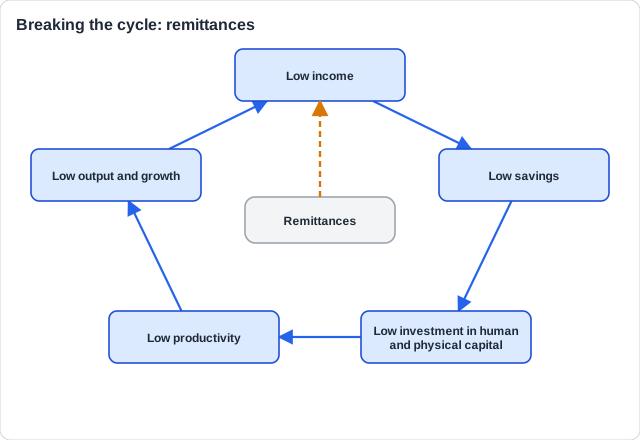
Using a poverty cycle diagram, explain how higher remittances could help break the poverty cycle.

Model answer plan

See the answer broken into clear points, with guidance on how each point earns marks.
Claim your free topic
A poverty cycle: low income, then low savings, then low investment in human and physical capital, then low productivity, then low output and growth, back to low income; remittances raises low income.
Remittances raise household income.

How the 4 marks are given

MarksWhat your answer needs
3–4A correct diagram and a correct explanation
1–2A correct diagram or a correct explanation, not both
3 at mostA diagram with a wrong or missing label

Try an IB Exam Question — Free AI Feedback

Test yourself on Poverty cycles. Write your answer and get instant AI feedback — just like a real IB examiner.

the term poverty cycle. [2 marks]

Related Economics HL Topics

Continue learning with these related topics from the same unit:

4.1.1Benefits of international trade4.1.2Free trade on a diagram: exports and imports4.1.3Absolute and comparative advantage (HL)4.1.4Limitations of comparative advantage (HL)
View all Economics HL topics
Improve your exam techniqueCommand terms, paper structure, and mark-scheme tips for Economics HL
Previous4.8.3Judging development: measures, growth and developmentNextEconomic barriers4.9.2

14 exam-style questions ready for you

Students who practice on Aimnova improve their scores by 15% on average. Get instant feedback that shows exactly how to improve your answers.

Practice Now — FreeView All Economics HL Topics