The big idea: An ionic solid is a giant lattice of oppositely charged ions held together by strong electrostatic attraction. Pulling that lattice completely apart costs a lot of energy.
Lattice enthalpy defined: Lattice enthalpy, ΔHlat⊖, is the enthalpy change when one mole of a solid ionic compound is converted into its gaseous ions:
MX(s) → M⁺(g) + X⁻(g)
Because you are breaking attractions, lattice enthalpy is always endothermic (large and positive).
Why it can't be measured directly: You can't sit in a lab and tear a salt crystal into a gas of free ions and read the heat off a thermometer — there is no single experiment that does it.
Instead we find ΔHlat⊖ indirectly, using a Born–Haber cycle: a closed enthalpy cycle built from steps that can be measured, combined with Hess's law.
See it drawn, step by step
In My Learning, handwritten diagrams build one step at a time. Play, pause and replay each explanation until it clicks. Create your free account to try it.
Free preview
This is the free notes preview
You're reading the free notes. Aimnova Pro unlocks the full study experience — and you can try it with your first topic free to keep:
- FlashcardsLock in vocabulary and key terms with spaced repetition.
- Practice questionsAnswer exam-style questions and get instant AI marking.
- Mock exams & past-paper vaultSit full mocks and see exactly how examiners award marks.
- Personalised study planA daily plan built around your exam date and weak areas.
A Born–Haber cycle is a step-by-step 'paper route' from the elements to the gaseous ions, then back down to the solid. Each step is its own measurable enthalpy term, and each has a characteristic sign.
| Step (for MX) | Enthalpy term | What happens | Sign |
|---|---|---|---|
| 1 | ΔHf⊖ (formation) | elements in standard states → 1 mol solid MX | usually − |
| 2 | ΔHatom⊖ (atomisation/sublimation) | metal solid → gaseous metal atoms | + |
| 3 | Bond dissociation (½ × per mole of bonds) | non-metal molecule → gaseous atoms | + |
| 4 | 1st ionisation energy | M(g) → M⁺(g) + e⁻ | + (always) |
| 5 | 1st electron affinity | X(g) + e⁻ → X⁻(g) | usually − |
| 6 | ΔHlat⊖ (lattice enthalpy) | MX(s) → M⁺(g) + X⁻(g) | + (large) |
Get the signs right: Each term in the cycle has its own sign. Check it before you add the terms up.
| Term | What it is | Sign |
|---|---|---|
| Atomisation / sublimation ΔHatom⊖ | Turning an element into gaseous atoms | endothermic (+) |
| Bond dissociation | Splitting a diatomic molecule (e.g. ½Cl2 → Cl). Use half the bond enthalpy if only one atom is needed. | endothermic (+) |
| Ionisation energy (IE) | M(g) → M⁺(g) + e⁻ (you remove an electron against attraction) | always endothermic (+) |
| First electron affinity (EA) | X(g) + e⁻ → X⁻(g) | usually exothermic (−) for the first electron added |
| Enthalpy of formation ΔHf⊖ | Forming the compound from its elements | usually exothermic (−) |
| Lattice enthalpy ΔHlat⊖ | solid → gaseous ions | endothermic (+) |
The classic sign trap: A first electron affinity is exothermic, but adding a second electron (e.g. O⁻ → O²⁻) is endothermic (+) — you push an electron onto an already-negative ion. For Group-16 oxides you must add both EA values, with the second one positive.
Atomizing bromine and iodine: Bromine is a liquid at 298 K, so making Br(g) takes two steps: vaporize Br₂(l) → Br₂(g), then half the Br–Br bond enthalpy. The enthalpy of atomization is for one mole of gaseous atoms: ½Br₂(l) → Br(g). Iodine (a solid) needs sublimation first in the same way.
See how examiners mark answers
Answer exam-style questions with model answers. Learn exactly what earns marks and what doesn't.
Set up the cycle so the direct route (elements → solid, ΔHf⊖) equals the indirect route (elements → gaseous atoms → gaseous ions → solid).
Then rearrange to make the unknown term — almost always the lattice enthalpy — the subject.
- standard enthalpy of formation of the ionic solid (kJ mol⁻¹)
- sum of atomisation (sublimation) + bond-dissociation steps to make gaseous atoms
- sum of the ionisation energies (always endothermic, +)
- sum of the electron affinities (1st EA usually exothermic, −)
- lattice enthalpy — solid → gaseous ions (endothermic, +)
- lattice enthalpy (kJ mol⁻¹) — the unknown
- atomisation + bond-dissociation enthalpies
- ionisation energies (+)
- electron affinities (1st usually −)
- enthalpy of formation of the solid (−)
Worked example — lattice enthalpy of sodium fluoride
Determine the lattice enthalpy of NaF, NaF(s) → Na⁺(g) + F⁻(g), from: ΔHf⊖(NaF) = −574; ΔHatom⊖(Na) = +108; ½ bond dissociation of F2 = +79; 1st IE(Na) = +496; 1st EA(F) = −328 (all kJ mol⁻¹).
Solution
- Formula first — rearrange the Born–Haber relation for the lattice enthalpy:
- Add up the 'route up to gaseous ions' (atomise Na, atomise ½F2, ionise Na, add e⁻ to F):
- Now subtract the (negative) formation enthalpy — subtracting a negative adds:
- Work it out — keep the sign and unit:
Final answer
ΔHlat⊖(NaF) = +929 kJ mol⁻¹ (endothermic, as expected for breaking a lattice apart).
See it drawn, step by step
In My Learning, handwritten diagrams build one step at a time. Play, pause and replay each explanation until it clicks. Create your free account to try it.
Worked example — a divalent ion: magnesium chloride
Determine the lattice enthalpy of MgCl2 from: ΔHf(MgCl2) = −641; atomization of Mg = +148; first and second IE of Mg = +738 and +1451; Cl–Cl bond enthalpy = +242; EA(Cl) = −349 (all kJ mol⁻¹).
Solution
- Two chloride ions: break one Cl₂ (+242, whole bond) and add two electrons (2 × −349 = −698). Two ionization energies make Mg²⁺: 738 + 1451 = +2189.
- Steps up to the gaseous ions:
- Close the cycle — lattice enthalpy = steps up − ΔHf:
Final answer
ΔHlat(MgCl2) = +2522 kJ mol⁻¹ (booklet +2540): double counts for the two chlorides, two ionization energies.
Sign discipline: The single biggest source of lost marks is a wrong sign, especially the − ΔHf⊖ term: subtracting a negative number adds its magnitude. Write every value with its sign in brackets before you add them up.
What the papers ask: You will not have to build a whole cycle from nothing. You will read one: name a step, fill in species or values, or find the one missing value by Hess's law.
How this is tested: Born–Haber cycles come up in HL Paper 1A and as 3-mark Paper 2 questions, and the lattice-enthalpy factors are a regular 1-mark item.
The question types
- Paper 1A: which arrow is the electron affinity; ΔHf from a cycle's values; which charges and radii give the largest lattice enthalpy; which reaction has the most negative ΔH (ions forming the smallest, most highly charged lattice); the atomization equation.
- Paper 2: annotate a cycle with species and process names, or with values from the booklet; determine a lattice enthalpy (including a divalent ion and a liquid non-metal); compare two lattice enthalpies.
The magnitude of lattice enthalpy is governed by the electrostatic attraction between the ions, which depends on two factors.
The two factors: Attraction (and so ΔHlat⊖) is larger when:
- Ionic charge is bigger — higher charges attract more strongly (the dominant factor). Mg²⁺/O²⁻ attract far more strongly than Na⁺/Cl⁻. - Ionic radius is smaller — smaller ions sit closer together, so the attraction is stronger. F⁻ gives a larger lattice enthalpy than I⁻ with the same cation.
Increasing charge
- Na⁺Cl⁻ (1+, 1−): ΔHlat⊖ ≈ +790 kJ mol⁻¹
- Mg²⁺O²⁻ (2+, 2−): ΔHlat⊖ ≈ +3791 kJ mol⁻¹
- Doubling both charges has a huge effect — charge is the dominant factor.
Decreasing radius
- NaF (small F⁻): ΔHlat⊖ ≈ +930 kJ mol⁻¹
- NaI (large I⁻): ΔHlat⊖ ≈ +700 kJ mol⁻¹
- Smaller ion → ions closer → stronger attraction → larger ΔHlat⊖.
Exam-style question — compare two lattice enthalpies (a)
Explain why the lattice enthalpy of magnesium oxide, MgO, is much larger than that of sodium chloride, NaCl. [3]
How to score the marks
- State that lattice enthalpy depends on the electrostatic attraction between the ions, which increases with greater ionic charge and smaller ionic radius. [1]
- Identify the charges: Mg²⁺ and O²⁻ are both 2+/2−, whereas Na⁺ and Cl⁻ are only 1+/1− — the larger charges give a much stronger attraction. [1]
- Add the size point: Mg²⁺ and O²⁻ are also smaller than Na⁺ and Cl⁻, so the ions sit closer together, further increasing the attraction → MgO has the much larger lattice enthalpy. [1]
Final answer
MgO has the larger lattice enthalpy because its ions carry larger charges (2+/2− vs 1+/1−) and are smaller, giving a much stronger electrostatic attraction.
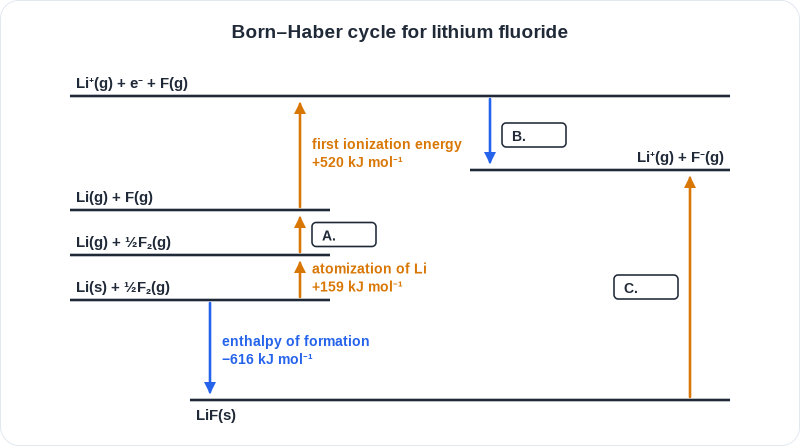
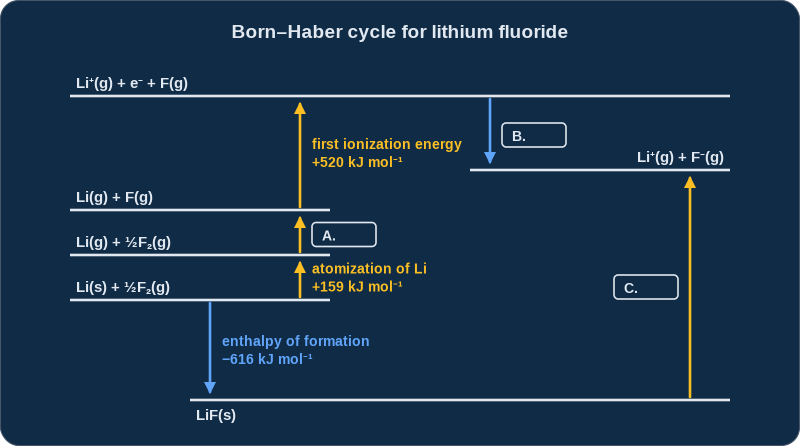
Exam-style question — annotate a Born–Haber cycle (b)
(b) The Born–Haber cycle for lithium fluoride is drawn with three empty boxes: A (between Li(g) + ½F₂(g) and Li(g) + F(g)), B (between Li⁺(g) + e⁻ + F(g) and Li⁺(g) + F⁻(g)) and C (between LiF(s) and the gaseous ions). Use ΔHf(LiF) = −616, atomization of Li = +159, F–F = +158 (sections 9 and 12: IE(Li) = +520, EA(F) = −328) and annotate A, B and C with values, in kJ mol⁻¹. [3]
How to score the marks
- Mark 1 — A, half the bond enthalpy: ½ × 158 = +79.
- Mark 2 — B, the electron affinity: −328 (negative sign required).
- Mark 3 — C, the lattice enthalpy: 159 + 79 + 520 − 328 + 616 = +1046.
Final answer
A = +79, B = −328, C = +1046 kJ mol⁻¹ (booklet 1049).
See it drawn, step by step
In My Learning, handwritten diagrams build one step at a time. Play, pause and replay each explanation until it clicks. Create your free account to try it.